Adriana García Galán
Interdisciplinary artist, researcher, and composer with a trajectory defined by an interest in the body, action,
and representation in the arts. Her work focuses on presence and on the ways in which human gestures
happen, are captured, and re-activated across sonic, graphic, and performative media, exploring the
threshold where experience meets symbolic structure and form. Her career spans both collective work and
individual practice. She is currently the Director of the Arts program at the Universidad del Rosario in Bogotá, Colombia.
Alice Kemp
Artist exploring an idiosyncratic praxis that involves audio composition, performance, installation, drawing, writing, lo-fi video, and object-making. Kemp is a Schimpfluch affiliate and a human ex-voto, living and working in Devon, England.
Allen Homburg
Anthea Caddy
Caddy creates large-scale spatial works—installations and performances in architectural and outdoor environments—that employ specialised loudspeaker and amplification systems to expand and expose the spatial phenomena embedded in the environments we inhabit.
Anthony Pateras
Australian composer, pianist and electronic musician based in Djaara/Castlemaine. Since 1999, he's produced a voluminous and broad-ranging body of work, performing hundreds of concerts, writing pieces for ensembles & soloists, and releasing albums on multiple international labels.
Arnaud Rivière
Musician and instrument designer. Co-founder and director of Sonic Protest Festival, and member of the ONCEIM ensemble. For decades, Arnaud Rivière has been a pillar of the Paris experimental music scene, and for many years, he was a booker for Instants Chavirés.
Arturo Hernández Alcázar
Artist based in Mexico City. The nature of Hernández Alcázar's work requires it to be destroyed, atomized, canceled, dissolved, or returned to economic circulation. Copper, smoke, iron, files, newspapers, coins, rocks, and fallen buildings form part of a work in constant transformation.
Audrey Chen
Vocal Artist based in Berlin. Chen performs solo and collaborates internationally with artists such as Phil Minton, Richard Scott, and Henrik Munkeby Nørstebø, and has appeared at festivals and venues across Europe, the Americas, and Asia.
Brett Wagg
Berlin-based artist and curator. Wagg is the sole operator of the Total Black label, founded in Montreal in 2012, and the Sentimental Youth brick-and-mortar record store in Berlin, specializing in Industrial Music, Noise, and Extreme Music.
Davide Tidoni
Artist working from the boundaries of physical, perceptual, and affective dimensions of sound. His work addresses questions regarding interactions with acoustic space, interdependence, and impermanence.
DUMA
Martin Khanja (aka Lord Spike Heart) and Sam Karugu emerge from Nairobi's flourishing underground metal scene as former members of the bands Lust of a Dying Breed and Seeds of Datura. In 2019, they formed DUMA (Darkness in Kikuyu).
Edka Jarząb
Vocal artist, DJ, and performer working with extended vocal techniques as a bridge between the public and private spheres. She is a contributor to Glissando and Wakat magazines and a founding member of Radio Kapitał.
Elvin Brandhi
Born Freya Edmondes. Improvising lyricist, producer, and sound artist, originally from Bridgend in Wales. She is one half of father/daughter noise-improv berserkers Yeah You, who released on Alter, Slip, Opal, Psychik Dancehall, and Good Food.
Felicity Mangan
Australian artist and composer based in Berlin, Germany. Her investigations and works are primarily influenced by the biomes of wetlands, waterways, and soil. She combines field recordings, electroacoustic composition, and electronic music techniques to create immersive, quasi-bioacoustic music aided by digital audio tools. Her compositions have been presented in multichannel installations, live performances, site-specific settings, and published works.
Florencia Curci
Curator, radio producer, and professor at the Universidad de San Martín (UNSAM) in Buenos Aires, Argentina. From 2017 to 2024, she directed the Centro de Arte Sonoro (CASo).
Giada Dalla Bontà
Italian researcher, curator, and writer focusing on the intersection between sound, politics, and experimental practices, with a particular emphasis on unofficial cultures in the late Soviet Union and in contemporary practices in Central and Eastern Europe, the Caucasus, Central Asia, and the Baltics.
Gustavo Costa
Percussionist and composer, active in experimental and underground music since the early 90s. He is a founding member and artistic director of Sonoscopia, a Porto-based organization dedicated to promoting experimental music and sound research in Portugal.
Hans Tammen
Musician, programmer, and educator. Tammen is currently teaching at the School of Visual Arts and NYU Steinhardt. From 2001 to 2014, he worked at Harvestworks Digital Media Art Center in NYC, where he was responsible for the Client Services, Education, and Artist in Residence program.
Ioana Vreme Moser
Romanian sound artist engaged with hardware electronics, speculative research, and tactile experimentation. She places electronic components in space and controls voltages through the interaction with her body, organic materials, lost and found items, and environmental stimuli.
Jessica Ekomane
Berlin-based electronic musician and sound artist. Her practice unfolds around live performances and installations grounded in an investigation of listening expectations and their societal roots.
Joshua Weitzel
Artist-curator working with Improvisation, electro-acoustic and experimental composition, installation art, jazz, inter-media projects, curating, and art mediation.
Junko
Japanese vocalist and a longtime member of Hijokaidan. Junko is perhaps best understood as an artist who radically expands her audience's interpretive capacities, working in a mode too improvisational to be punk, too chaotic to be free jazz, and yet too intimate to be dismissed.
Luciano Maggiore
Musician working in the field of electroacoustic music and sound diffusion. His works are published by Balloon & Needle, Boring Machines, Consumer Waste, Palustre, Senufo editions, 1000Füssler, Triscele Registrazioni, and Tulip Records. He lives and works in London.
Luka Murovec
Berlin-based architect and spatial practitioner, and core collaborator with raumlaborberlin since 2014. For documenta fifteen (2022) he co-designed X, a sound diffusion system and architectural intervention with Kunsthochschule Kassel's Department of Sound, leaving a permanent sculpture in Karlsaue Park.
Makoto Oshiro
Berlin-Tokyo-based performer and artist. He is also a member of the live installation/performance group The Great △ (夏の大△) with Takahiro Kawaguchi and Satoshi Yashiro. Oshiro runs the label Basic Function.
Mark Fell
Multidisciplinary artist based in Rotherham. Over the past 30 years, Fell's output has grown into a significant body of work – from early electronic sound works and recorded pieces, to installation, critical texts, curatorial projects, educational systems, and choreographic performances.
Marta Zapparoli
Sound artist and performer working with electromagnetic pollution and natural radio phenomena through a wide range of receivers, detectors, and signal demodulators. Zapparoli is also a founder member of Splitter Orchester.
Mattin
Artist, musician, and theorist working conceptually with noise and improvisation. Through his practice, writing, and pedagogy, he explores performative forms of estrangement as a way to deal with structural alienation.
Michelle Atherton
Artist and academic living in London. She is interested in experimenting with what might lie beyond human perception and how we might undo reductive binaries between the living and the non-living. The works often use a remix aesthetic incorporating sound, image, and text to create fragmented narratives as hooks to explore our slippery perceptions of the world.
Nick Klein
Berlin-based artist and curator. Klein has recorded a large amount of music for tape, CD, digital file, and vinyl editions for music labels, as well as running his own amorphous label project PL (primitive languages, Psychic Liberation).
Oren Ambarchi
Australian musician. Ambarchi has released numerous recordings for labels such as Touch, Editions Mego, Drag City, PAN, Southern Lord, Kranky, and Tzadik.
Oswald Berthold
Scientist, programmer, and artist. Founder of farmersmanual (1995), a renowned pan-European electronic music collective; co-owner with Florian Hecker of fals.ch (1998). Berthold has been working increasingly on real-time data-driven generative music since the early 2000s, specializing in AI and robotics.
Roc Jiménez de Cisneros
Barcelona‑based artist and experimental musician known for his long‑standing work at the intersection of sound, algorithmic composition, and rave culture. His work has been released by Entr'acte, Editions Mego, Presto!? and fals.ch, and on his own record label, ALKU, which he co-directs with Anna Ramos since 1997.
Rubén Patiño
Artist based in Amsterdam who explores sound generated by electronic means and its potential to transform the perception of space. Patiño's practice tends to challenge standardized formats of presentation that blend the boundaries between concerts, public events, and installations.
Rudolf Eb.Er
Also known as Runzelstirn & Gurgelstøck, Eb Er. founded the Schimpfluch extreme and outsider artist collective in Zürich in 1987. Rudolf Eb.er's research de-occults the psychic body through psycho-physical tests and trainings.
Russell Haswell
In addition to his work in galleries, nightclubs, and festivals, he has also released a huge amount of records and CDs on labels including Editions Mego, Warp, and Diagonal Records. Haswell is perhaps most well known for creating highly innovative, often improvised, experimental, critical, and abrasive works.
Víctor Mazón Gardoqui
Spanish-born sound artist, researcher, and educator whose work explores perception, altered states, and the invisible layers of sound and electromagnetic phenomena through experimental processes, custom electronics, and locative audio.
Volker Zander
Composer, curator, radio author, and founder of the label Apparent Extent. Zander has produced numerous records, catalogues, and actions by international visual artists. He has also been co-curator of the sound art exhibition Brückenmusik in Cologne since 2017.
Woonjii
DJ. Founder of experimental collective Yisekai, and a veteran crate digger based in Hong Kong. Woonjii worked in music promotion and licensing, managing copyrighted music for retail brands across the Asia-Pacific region.
Yan Jun
Based in Beijing, he's a key figure in China's underground scene, founding the Sub Jam label and performing globally, known for unique, often subversive live shows involving audience homes, body sounds, and exploring sonic consequences of movement.
Mon 12–16 · Tue 10–16 · Wed 12–16
cortex
1x Midas M32R LIVE
Compact 40-input digital mixing console with 16 Midas PRO mic preamps, 25 mix buses, and 17 motorised faders. Includes 8 true-stereo effects engines, 192 kHz ADC/DAC converters, and a DN32-LIVE expansion module providing 32-channel USB 2.0 multitrack recording. Features a 7-inch full-colour touchscreen display.
1x Sony VPL-FX30
3LCD installation projector delivering 4,200 ANSI lumens at XGA (1024×768) native resolution using Sony BrightEra 0.79-inch panels for improved contrast and reduced flicker. Supports HD input signals including 720p, 1080i, and 1080p with a 2000:1 contrast ratio.
1x Ampeg SVT-810E
800-watt sealed bass cabinet built on Ampeg's original 1969 infinite-baffle design, housing eight 10-inch drivers with 2-inch voice coils in a Baltic birch plywood enclosure. Delivers 100 dB sensitivity and a peak SPL of 130 dB, handling 800 W mono or 2×400 W stereo at 4 Ω mono / 2×8 Ω stereo impedance.
8x Meyer Sound MM-4XPD (135 Hz – 17 kHz)
Self-powered miniature loudspeaker in the hypercardioid variant, designed for installations requiring controlled rear rejection and tight dispersion in reverberant spaces. Integrates a Class-D amplifier with Meyer Sound's IntelligentDC technology, powered and fed audio over a single EN3 5-pin cable.
4x Meyer Sound MM-10XP (35 Hz – 208 Hz)
Self-powered miniature subwoofer with a single 10-inch driver and onboard Class-D amplifier with integrated DSP for crossover alignment, driver protection, and phase correction. Achieves 118 dB linear peak SPL across a 33–228 Hz operating range, powered by an external 48 V DC IntelligentDC supply.
2x Meyer Sound VLFC (13 Hz – 30 Hz)
Self-powered very-low-frequency system using two 18-inch long-excursion drivers and a 5,600 W peak Class AB/H bridged amplifier, covering 13–30 Hz (±4 dB) — the lowest operating range of any Meyer Sound product. Designed to extend the system into infrasonic territory, producing 125.5 dB peak SPL.
1x Pioneer DJM-V10-LF
Six-channel professional DJ mixer with a 64-bit mixing engine and 32-bit A/D and D/A converters. Features a 4-band EQ per channel with an integrated per-channel compressor, a 3-band master isolator, and a send/return FX loop. The -LF suffix designates 60 mm long faders in place of the standard 45 mm. Supports rekordbox DVS, Serato DVS, and TRAKTOR PRO 3.
2x Pioneer CDJ-3000x
Pioneer's flagship standalone media player with a 9-inch full-colour HD touchscreen and a redesigned jog wheel with reduced touch latency. Connects via Gigabit Ethernet Pro DJ Link for up to six units, with CloudDirectPlay enabling direct streaming from rekordbox without a USB drive. Compatible with Serato DJ Pro and TRAKTOR PRO 3 via USB-HID.
2x Ecler Warm2 Rotary Mixers
Two-channel analogue rotary mixer built around Alps Blue Velvet potentiometers, with a 3-band full-cut EQ per channel and a 3-band master isolator with crossover points at 300 Hz and 4 kHz (±infinity/+12 dB, 24 dB per octave). Accepts two phono and three line sources per channel, with XLR master output and RCA booth output.
2x Denon DJ SC6000M [ 500 GB HD Archive — linked ]
Standalone media player with an 8.5-inch motorised platter driven by a brushless DC motor with adjustable torque, paired with a 10.1-inch multi-touch display. Streams directly without a laptop from Beatport LINK, Beatsource LINK, SoundCloud GO+, TIDAL, and Dropbox via built-in Wi-Fi. 24-bit/96 kHz audio output; supports AIFF, FLAC, ALAC, and WAV formats.
2x Technics SL-1210MK7
Direct-drive turntable built around a coreless motor that eliminates cogging for smoother rotation, producing 1.8 kgf·cm starting torque and reaching 33⅓ rpm from standstill in 0.7 seconds. Features four-step adjustable torque and brake speed, ±8%/±16% digital pitch control, and an S-shaped universal static-balance tonearm with 230 mm effective length.
2x Ortofon Concorde MKII
Moving magnet cartridge in Ortofon's integrated Concorde body format, designed for DJ applications with robust groove tracking at higher stylus forces. Produces 6 mV output, frequency response of 20–20,000 Hz, and is built for repeated back-cueing and scratching with consistent channel separation and minimal sibilance distortion.
2x Tascam 202MKVII Cassette Decks
Rackmount dual-cassette deck with two independently recording transport decks, supporting Type I (normal) and Type II (chrome) tapes. Outputs digitised audio via USB 2.0 at up to 48 kHz/16-bit and provides ±12% pitch/tempo adjustment per deck. Used for playback and recording of the station's cassette archive.
2x Sennheiser HD 25
Lightweight supra-aural closed-back monitoring headphone with a rotating capsule for single-ear monitoring and a split headband to reduce low-frequency resonance transmission. 70 Ω impedance, rated to 120 dB SPL, THD below 0.3%, weighing 140 g. Industry standard in broadcast and DJ monitoring environments.
1x Apple Mac Mini M2 running Max/MSP — BUTT
Dedicated machine running Max/MSP for real-time audio routing and signal processing, paired with BUTT (Broadcast Using This Tool) for encoding and streaming the live signal to p-node.org. Built around Apple's M2 chip (8-core CPU, 10-core GPU) with up to 24 GB unified memory and Thunderbolt 4 connectivity.
1x Apple Mac Mini M2 running VLC
[ 24/7 Streaming via p-node.org ]
Always-on machine running VLC for continuous automated streaming, maintaining the station's 24/7 broadcast when no live session is active. Serves the archive as a continuous programmed stream through p-node.org, running on the same M2 platform as the live machine.
1x Motu 16A
32-in/34-out audio interface offering 16 balanced TRS analogue inputs and 16 analogue outputs, two banks of 8-channel ADAT optical I/O, dual Thunderbolt 4/USB 4.1 ports, and two Gigabit AVB Ethernet ports for networked audio distribution. Dynamic range reaches 120 dB (A-weighted) on line inputs, with sample rates up to 192 kHz.
1x 5:4 Multi-Touch Panel
Resistive multi-touch display in 5:4 aspect ratio used as an interactive control surface. Configured for custom interface layouts in Max/MSP, enabling tactile control of processing parameters, stream management, and archival playback.
2x Meyer Sound MM-4XPD (Outdoors) (135 Hz – 17 kHz)
Weatherised version of the MM-4XPD for the outdoor listening area. Same hypercardioid dispersion pattern and IntelligentDC powering as the indoor units, with UV and moisture resistance for outdoor installation.
1x Meyer Sound MM-10XP (Outdoors) (35 Hz – 208 Hz)
Self-powered subwoofer for the outdoor system, matched to the outdoor MM-4XPD array for full-range coverage in the exterior listening zone. Same onboard DSP and 33–228 Hz operating range as the indoor subwoofer.
ALM. ASQ-1: Multimode Sequencer
8-step sequencer with multiple operational modes including traditional step, Euclidean, and chord sequencing. Independent CV and gate outputs with clock division and pattern chaining.
ALM. Mega Tang: Four Channel Linear VCA and Stereo Mixer
Four independent linear VCAs with individual CV control, configurable as a four-channel mono processor or a two-channel stereo submixer. Unity-gain design for transparent signal routing.
ALM. Squid Sample: 8 Channel Audio & CV Sampler
Eight-track sampler loading audio and CV files from SD card. Each channel has independent pitch, trigger, loop, and direction control, enabling complex polyphonic or percussive playback arrangements.
ALM. MCO (Legacy): Compact Digital VCO
Compact digital oscillator with multiple waveform outputs — sine, triangle, sawtooth, and pulse — plus a sub-oscillator one octave below. Designed for minimal HP footprint.
ALM. Beast's Chalkboard: Octave Switcher + More
Handles octave transposition, portamento/glide, and note quantisation. Designed for keyboard or sequencer integration, translating incoming pitch CV into clean octave intervals.
ALM. Pamela's PRO Workout: Clocking Modulator
Eight independent clock outputs, each configurable with Euclidean rhythms, clock multiplication and division, LFO waveforms, probability, and swing. Functions as the timing backbone of a system.
ALM. MFX: Stereo Multi Effects Processor
Stereo effects unit with reverb, delay, chorus, phaser, and pitch-shifting algorithms. Key parameters are voltage-controllable, allowing dynamic modulation of spatial and temporal effects.
ALM. Tyso Daiko: Dual 12 Bit Digital Drum Voice
Two independent 12-bit digital percussion synthesisers. Each voice combines oscillator and noise sources with decay envelopes, covering kick, snare, tom, and noise-based sounds.
ALM. MCFx2: Dual State Variable Filter
Two independent state variable filters with simultaneous lowpass, bandpass, and highpass outputs per channel. Usable in series or parallel for subtractive shaping and frequency splitting.
ALM. Pip Slope: Compact Envelope Generator
Compact 4HP attack-release envelope with looping capability. Functions as an AR envelope on gate input or as a free-running LFO when looped, covering slow modulation to audio-rate cycling.
ALM. Akemie's Castle: Digital FM Dual VCO
Complex FM oscillator built around the Yamaha OPN chip architecture. Two operators with four selectable FM algorithms produce classic digital FM timbres ranging from bell-like harmonics to dense inharmonic spectra.
ALM. Quaid Megaslope: Multi-Mode Modulator
Four-stage function generator configurable as ADSR, AD, AR, or multi-stage complex envelope. Also operates as a tempo-synced or free LFO with voltage control over all stage durations.
ALM. HPO: Headphone Output
Stereo headphone amplifier with volume control. Converts modular signal levels to headphone-compatible output for direct monitoring without external hardware.
ALM. Passive Mult: 3HP Passive Multiple
Passive signal splitter in 3HP. One input divided across multiple outputs with no active buffering — suitable for CV distribution in low-impedance contexts.
COSMOTRONIC. Messor: Compressor and Transient Shaper
Stereo VCA compressor with threshold, ratio, attack, and release controls, combined with a transient shaper offering independent punch and sustain parameters. Useful for dynamic control of percussive or mixed signals.
COSMOTRONIC. Delta V: Dual Function Generator
Two independent function generators with voltage-controllable rise and fall times. Each can operate as an envelope triggered by gate or trigger inputs, or as a looping LFO with linear or exponential curves.
COSMOTRONIC. Vortex: Complex Dual Oscillator
Two analogue VCOs with linear FM, hard sync, and waveshaping. Designed for crossmodulation and complex timbral interaction, producing rich harmonic and inharmonic spectra.
COSMOTRONIC. Cosmix: Stereo Mixer
Compact stereo mixing module with per-channel level and pan controls. Clean signal path for submixing audio voices before output or further processing.
COSMOTRONIC. Peradam: Side Chained Distortion
Wavefolder and distortion unit with integrated sidechain ducking. An external trigger signal rhythmically reduces the distorted output amplitude, combining saturation with dynamic shaping.
EXPERT SLEEPERS. ES-9: 16-in/16-out USB Audio Interface
16-channel bidirectional USB audio interface bridging the modular system and a DAW at audio rates. Sends and receives both audio and CV, enabling tight software-hardware integration and multi-channel recording.
NOISE ENGINEERING. Cursus Iteritas Alia: Additive Oscillator Based on Dynamically Generated Wavetables
Additive oscillator generating dynamically evolving wavetables from a set of selectable harmonic modes. Each mode emphasises a different spectral structure, from smooth sine-based tones to dense, noisy textures.
ADDAC. VC Looper & Granular Processor: Granular Sampler
Voltage-controlled audio looper with integrated granular engine. Records and plays back loops while applying grain size, density, position, and pitch controls for live granular transformation of incoming audio.
ADDAC. VC T-Networks
Voltage-controlled passive attenuator using resistor ladder topology. Enables smooth CV-driven blending and attenuation of signals in a compact, low-noise format.
ADDAC. VC Triple Bandpass Filter
Three voltage-controllable bandpass filters with independent centre frequency and resonance per band. Can be used in parallel for formant-like filtering or in series for narrow spectral sculpting.
ADDAC. Balanced Inputs
Utility module converting balanced XLR line-level signals to unbalanced modular-level CV or audio. Enables clean interfacing with studio microphones, mixers, and external instruments.
ADDAC. Balanced Outputs
Converts unbalanced modular-level signals to balanced XLR output for connection to studio mixers, PA systems, or audio interfaces. Provides impedance matching and ground isolation.
ADDAC. REV2 VCO
Analogue VCO with sawtooth, triangle, sine, and variable-width pulse waveforms. Voltage control over pitch and pulse width, with hard sync and linear FM inputs for timbral modulation.
ADDAC. VCA Quintet Mixing Console
Five VCAs with individual CV control over gain, functioning simultaneously as a five-channel mixing console. Suited for polyphonic voice mixing or multi-source submixing with dynamic level control.
ADDAC. VC Fixed Filterbank
Voltage-controlled filterbank with fixed frequency bands across the spectrum. Each band level is adjustable via CV, enabling graphic EQ-style processing, formant filtering, and spectral morphing.
RITUAL ELECTRONICS. Aranea: 5x5 Matrix Mixer
Five-input, five-output matrix mixer where any input can be routed to any output at continuously variable levels. Essential for complex signal distribution, feedback network construction, and generative patching.
MAKE NOISE. Spectraphon: Spectral Degradation
Spectral processing module based on the superformula algorithm. Two partially overlapping synthesis voices manipulate the spectral content of incoming audio, producing harmonic degradation, spectral folding, and inharmonic transformation.
NEUZEIT INSTRUMENTS. Warp: Wavetable and Additive Synthesis
Hybrid oscillator combining wavetable scanning with additive layering. Multiple simultaneous partials can be shaped and morphed across wavetable positions, producing rich, evolving timbres from simple to highly complex spectra.
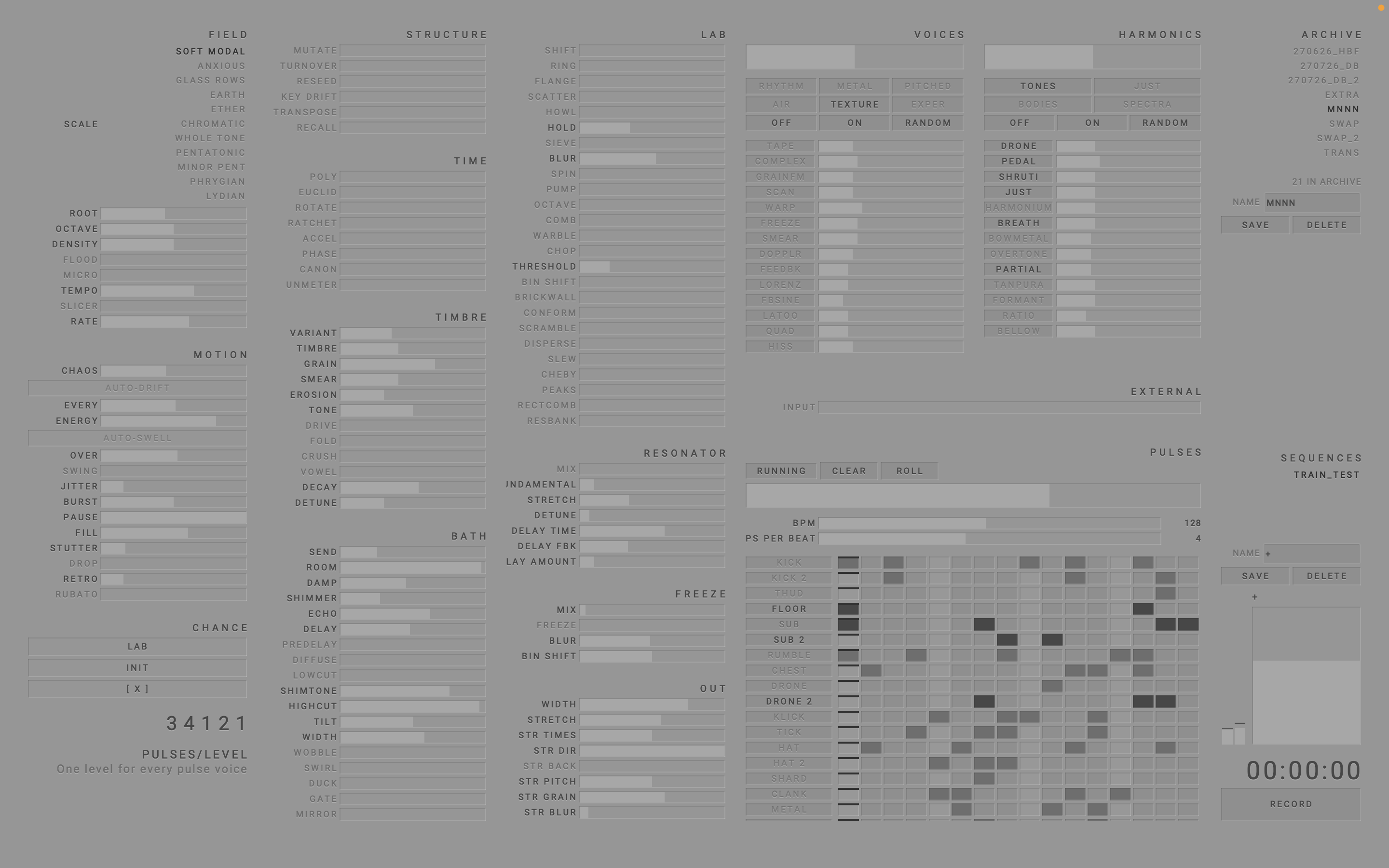
Software
34121
D14SPORA is a digital studio designed and developed by MNNN as a didactic tool for the Department of Sound at the Kunsthochschule Kassel.
Part performance system, part autonomous sonic environment, it unfolds through an ensemble of independent voices. Each voice can act as a living agent: listening, generating, responding, and finding its own path through a shared sonic field. Nothing is prerecorded. Nothing is fixed. Each voice develops its own tendencies and sense of time, guided by a common root and scale.
From these conditions, something unstable begins to take shape. Voices intersect, diverge, resonate, and fall away. No composition is predetermined; structure emerges through their ongoing encounters and interactions.
D14SPORA is a system in continual becoming: A digital space where temporal events relate and evolve, and where complex forms are not imposed, but discovered.
STRUCTURE
The ensemble is divided into three main collections.
VOICES
168 voices arranged as twelve banks of fourteen. D14SPORA's primary sound generators.
STRUCK AND RESONANT BODIES
A bank of tuned modes - a ratio, a level, and a ring time for each - set going by a burst a few milliseconds long. The strike decides only how the sound begins; the body decides what it is, which is why one excitation makes a bell, a bowl or a plate depending on what it is thrown at.
PHYSICAL MODELS
The instrument as a delay line rather than as a spectrum. A plucked string is noise sent round a loop the length of the string and filtered a little on every lap; the mesh is four such loops meeting at a junction, scattering one strike between them until it settles. Nothing here is a recording of anything.
GRANULAR PLAYBACK
Grains read from buffers the instrument records into itself while it loads - five seconds apiece, its own sound rather than a library's. Density, position, rate, and window are separate controls, so the same five seconds is a texture, a stutter, or a held chord depending on where they sit.
SPECTRAL VOICES
The sound is taken apart into two thousand bins, altered as a spectrum, and put back. Bins are scrambled, frozen, thinned to their peaks, or moved; what comes out keeps the material's colour and loses its behaviour, which is what makes a freeze sound like a room rather than like a loop.
CHAOTIC OSCILLATORS
Deterministic systems that never repeat - a Lorenz attractor, a sine folded back through its own output. Not noise: the shape is stable, and the detail is never twice the same, which is drift at low rates and a source in its own right at high ones.
ELASTIC, VOCAL, HARSH, ELECTRIC, IRREGULAR, AND ORGANIC TIMBRES
Not a sixth kind of voice but the ground the five above cover between them. Each is built to reach several of these rather than to hold one, which is why moving a single fader crosses from one to another instead of giving more of what was already there.
HARMONICS
168 voices arranged as twelve banks of fourteen.
Voices tuned to integer multiples of the global root rather than to the active scale. Because every pitch is derived from the harmonic series, the prism remains internally consonant even as the musical scale changes.
The voices include just-intonation intervals, microtonal relationships beyond equal temperament, and spectral treatments derived directly from the harmonic series.
PULSES
70 voices driven by an independent sixteen-step sequencer, the last twelve of them a bass section.
Unlike the free-running families, pulse voices are synchronised to their own clock. Four voices replay the external input rather than synthesising sound directly, allowing live material to participate in the rhythmic layer.
5P3C5
VOICE GROUPS
D14SPORA is organised into three independent voice groups. Each group employs a distinct method of sound synthesis while sharing the same global temporal field.
HARMONICS
Rather than following the active scale, harmonic voices are tuned to integer multiples of the global root frequency. This preserves consonant relationships throughout harmonic changes, regardless of the selected scale.
JUST INTONATION
Intervals as whole-number ratios rather than as equal steps: the triad is 4:5:6, and tuned that way its thirds beat with nothing at all. The stillness is only audible while two voices hold the interval, so it wants sustain and few notes.
SEPTIMAL AND UNDECIMAL INTERVALS
Dyads on ratios no equal temperament can reach. Seven over four is the flat seventh that makes something sound archaic rather than modal; eleven over eight falls halfway between a fourth and a fifth and belongs to neither, and that ambiguity is the whole of it.
UNDERTONE SERIES
The harmonic series the other way up: the root divided rather than multiplied, so the partials fall below it instead of above. The same arithmetic downwards, and what it builds is a chord under the note rather than a colour on top of it.
PYTHAGOREAN STACKS
Pure fifths piled one on the next until they leave the octave. Nothing is tempered to make them fit, so the thirds arrive wide and restless - what western music used before it wanted chords - and under a long stretch they beat slowly enough to be heard as movement rather than as error.
BOHLEN-PIERCE STRUCTURES
Built on a twelfth rather than an octave and divided into thirteen, so nothing in it is an octave apart. The prism's harmonic layout disagrees with it entirely, which is worth hearing once.
BEATING PAIRS
Two partials sounding together a fraction of a hertz to twelve hertz apart. Neither is heard as a pitch of its own; what is heard is the difference between them, the amplitude swelling and falling as many times a second as there are hertz in the gap.
DIFFERENCE TONES
Two high partials spaced so the difference between them lands back on the root - seven times it and eight times it, whose difference is it. The root is played quietly underneath as well, so the tone the ear constructs and the tone that is actually there arrive together.
PULSES
Pulse voices operate on their own clock, independent of the global temporal field. Instead of freely generating phrases, they derive rhythmic structures from the sequencer while maintaining independent pattern lengths, rotations, and timing relationships.
Several rows share the same synthesis engine at different fundamental frequencies - for example, two kick voices or four sub-bass voices - allowing related sounds to interact as a coherent rhythmic system rather than as isolated instruments.
DYNAMIC STRUCTURE
D14SPORA can operate without user intervention. A dedicated structure engine continuously reshapes the musical state by adjusting its own parameters, enabling and disabling voices, changing scale and root, transposing the harmonic field, rerecording its source material, and recalling previously stored states.
Rather than following a predetermined sequence, the studio engine can gradually reorganise the ensemble over time, producing long-form evolution while preserving the independence of each voice.
PRESETS
A preset captures the complete state of the system, including all continuous control parameters. Stored presets may be recalled at any time, allowing the structure engine to revisit earlier configurations as part of its autonomous behaviour.
Transitions between states are performed by interpolation. During a morph, continuous parameters are updated at 25 frames per second, producing smooth changes throughout the studio engine.
Discrete parameters are excluded from interpolation. Voice activation states are switched directly rather than blended, and the sequencer grid is stored and recalled independently of the continuous parameter set.
VOICE ARCHITECTURE
Every voice consists of three independent components.
SYNTHDEF
Produces the sound itself. One synthesiser instance is created for every note that the voice generates.
PDEF
Generates musical events. The pattern determines when notes occur and supplies parameters such as pitch, duration, articulation, register, and timbre.
CONTROL BUSES
Continuously changing values read by active synths. Pattern values are evaluated only once, when a note begins.
Continuous controls are therefore read directly inside the running SynthDef from dedicated control buses. Parameters including level, energy, chaos, and effect sends remain responsive throughout the lifetime of every note.
Changing the level of a sustained voice affects the note already playing rather than waiting for the next phrase.
INTERNAL BUILDS
Every voice contains three internal constructions. Oscillator topology, excitation model, resonator configuration, or modal ratios, depending on the voice.
One build is selected for each phrase and remains active until that phrase has completed. The result is that a single voice can produce substantially different timbres without changing its musical behaviour.
VOICE CONTROLS
Opening a voice exposes multiple parameters dedicated to that voice.
RATE
How often this voice speaks, from a tenth of the field's pace to eight times it.
PHRASE LENGTH
How long each phrase runs, on the same scale as the rate: a tenth of the field's measure to eight times it.
REGISTER
The octave the voice sits in, three either way from where its family puts it.
SEND LEVEL
How much of this voice reaches the sections its family sends to, up to three times unity.
BUILD SELECTION
Which of the three builds this voice uses. Below zero, it follows whatever the family is set to.
SPECTRAL CONTROLS
RESONATOR CONFIGURATION
How many modes the bank holds and how they are spaced. The same excitation through a different configuration is a different object, which is why a bank is a family of instruments rather than one with a tone control.
PARTIAL DISTRIBUTION
Where the partials sit above the fundamental. Whole multiples give a pitch; anything else gives a body that rings without settling on a note.
RESONANCE
Resonance at the cutoff. Up, the filter rings and the module gains a pitch of its own beside the carrier's.
SPECTRAL BALANCE
Which end of the bank is loudest. It decides whether a struck thing reads as wood, metal or glass without changing a single frequency in it.
FILTER CONTROLS
FILTER TYPE
Which of the fifty filters the voice is played through. Each opens its own panel, so several can be set up and left, and the choice is a character rather than a setting.
CUTOFF
A low-pass after the folding, in hertz.
RESONANCE
Resonance at the cutoff. Up, the filter rings and the module gains a pitch of its own beside the carrier's.
DRIVE
Saturates this voice alone, before anything downstream. The gain is compensated, so it thickens rather than simply getting louder - it decides how hard the signal arrives rather than how much of the result is mixed back in.
Pulse voices provide an additional eleven parameters governing sequencer behaviour, including rhythmic generation, rotation, probability, and timing.
RESOURCE ALLOCATION
Resonators and filters are created only when required. A voice whose filter remains at its neutral position allocates no filter resources. Likewise, resonators exist only while their controls depart from zero. This dynamic allocation avoids maintaining thousands of permanently running processors.
A permanently allocated resonator for every voice would require approximately 2,800 simultaneous filters.
SIGNAL PATH
D14SPORA transforms digital audio through a succession of interconnected processing stages.
SOURCES
The six families that make sound: the external input, playback, voices, harmonics, pulses, and the FM module. Each has its own level and its own sends.
FILTER
Fifty filters, each a body rather than a setting. The section's cutoff and resonance are the gesture; each filter offsets them and adds its own character.
SKEW
The distortions: fuzz, germanium, crush, decimate, wavefold, tube, diode. Separate bodies, because the difference between them is not a number.
GATE
A rhythmic cut on its own clock — depth, rate, and the edge of each step, from a click at the bottom to a tremolo at the top.
UNREST
A delay line with a feedback loop and four filters — what a filter does to pitch, done to time. A smear at one end, a stutter at the other.
CAVITY
A bank of tuned resonators that answers what is sent to it with its own pitches rather than the material's. Rings on after the source has stopped.
LAB
The lab's one way in. Every family can send a copy of itself here, and this is what those copies arrive at before any of the nine sections below act on them — so it is the level everything else in this drawer is working from.
STRETCH (ONE PER FAMILY)
The same machine at every family, reading behind the write head, so a family can be heard stretched, held, or reversed beside its own direct path. The harmonics family has a prism here instead.
MASTER STRETCH
The master's own stretch. The same machine the families have, listening to the finished mix rather than to one send.
BUS
The compressor across the whole mix, and the headroom before it. It replaces the mix rather than adding to it, so it never stops running.
OUTPUT
The last stage before the card: colour, width, headroom, compression, and a limiter, per channel.
The harmonics family's stretch is a prism instead, with its own reverb after it.
Nine stages take a send from each family. The routing grid lists them in the order they appear in a family's panel.
LAB
How much of the external input goes to the lab. Its own, rather than the one every voice reads - which is why the input arrived there whether or not it was wanted.
FILTER
How much of the external input goes to the filter section. It is a separate path, so direct at zero and this one up gives the filtered signal alone.
SKEW
How much of the external input goes to the skew section.
GATE
How much of the external input goes to the gate. Because it is a send and not an insert, the input can be chopped on the gate's own clock while everything else in the ensemble runs on undisturbed.
UNREST
How much of the file goes to the unrest module - the delay that stretches and contracts what it is given. Nothing is taken from the direct path: this is a copy, and what comes back arrives beside it.
STRETCH
How much of the file goes to its own stretch.
PRISM
How much of this module goes to its own prism. A send of its own, so the prism can be used without the stretch and the other way round.
YIELD
Pulls the tail down while the input is loud and lets it back when it stops, so a dense passage stays legible, and the reverb is heard in the gaps. It's the last of them and the send that leaves the family for the master; a family whose yield is shut is audible only through whatever else it was sending to.
Each stage consists of one or more synthesis nodes that read from the audio bus written by the preceding stage. In addition to the main signal path, voices may send audio to a shared room bus and to dedicated cavity buses, allowing individual resonators to operate independently of the main processing chain.
The processing order is intentional. The recorder precedes the stretch processor so that the recording buffer always contains the original signal rather than the stretched output. Reversing this order would cause the recorder to capture its own processed output, creating an unstable feedback loop.
The master stage performs four operations in a fixed order:
- Replace invalid floating-point values (
NaNand +/-inf). - Limit sample values to the range +/-8.
- Apply the master output gain.
- Apply compression and final limiting.
This order is essential. Invalid floating-point values cannot be removed simply by multiplying them by zero; they must first be replaced with valid samples. Likewise, limiting is applied after the master gain so that the final output level reflects the actual signal presented to the limiter.
STRETCH
There is one stretch chain per family: voices, harmonics, pulses, external, playback, and FM. Each has its own send bus, its own eight-second buffer, its own recorder and its own player, so the material never mixes before it is stretched, and `stretch` on the pulses is the pulses.
Each family carries its own full set of handles, twenty-five of them, in its own panel.
LEVEL
How much of this family's stretch is heard, besides its direct path and its other sends. Without it, the separation is only in the buffer: the family could be stretched on its own but not heard at a level of its own.
TIMES
How long each mode rings. Short is a knock and long is a bell, and the spread between the shortest and the longest is what makes a body sound struck rather than played.
DIRECTION
Forward, frozen, or backward. In the middle, the read head stops, and the grains keep overlapping at that one spot, which is a moment held open.
BACK
How far behind the write head the stretch reads, up to about seven seconds. With hold, it becomes a scrub through what the family has just done.
PITCH
The pitch of the file, without touching its speed. Two octaves either way. Separating the two needs grains - the dry path is a tape, where speed and pitch are one thing - so moving this brings in as much grain as it takes. `grain` decides the character above that; at unison this does nothing and the file is read straight.
GRAIN
At 0, the file is read straight from the buffer - no grains, nothing added, and speed and pitch are one thing, as they are on tape. Above 0, it is granulated, and the two come apart: how long each grain is. Short is a texture and loses the file's own rhythm; long keeps it and smears the transients less.
BLUR
Scatters the grains in time so they stop landing on a grid. Without it, a long window repeats audibly at the window's own rate.
HEADS
How many playback heads read the buffer at once, one to four. One is a tape; four is a cloud, and everything between is how thick the stretch becomes.
SPAN
How far apart those heads sit in the eight seconds. Small keeps them together as a thickening; large has them reading different moments at the same time.
SPRAY
Moves each head a little on its own, in position and in pitch. This is what stops several heads sounding like one loud one.
SPREAD
How much of the file the scale is spread across. Narrow and it is one region read at different pitches; wide, and each degree of the scale is its own material, so the file is an instrument with twelve different sounds in it.
TILT
What the stretched signal keeps: lows below the middle, highs above. A stretch is mostly sustain, and this decides whether that sustain sits under the mix or over it.
FEED
Feeds the stretch back into itself, so what it produces is stretched again. Near the top, it stops being an effect on a source and becomes a drift of its own.
FEED TONE
What survives a lap of the feedback. Below the middle, the loop keeps the low end and darkens with every pass; above it, the loop keeps the top and thins. It is the difference between a feedback that drifts somewhere and one that only grows.
SNAP
How sharp the attack of every pulse voice is. Low is soft and rounded; high is a click on the front of the sound.
WARP
Bends the read pointer itself, so pitch and time bend together the way tape does and a pitch shifter cannot. Low is wow; high enough and the rate crosses zero, so the head reverses inside a grain and overshoots coming back.
WARP RATE
How fast the bend runs, from once every fifty seconds to thirty times a second. Above about ten, it stops being a warp and becomes a sideband.
WARP SHAPE
Sine at one end, triangle in the middle, stepped random at the other: a smooth waver, or a machine losing and regaining its grip.
JUMP
Throws the read head somewhere else in the thirty seconds, at the rate below. With snap up it is a hard edit between two moments of what the ensemble has just done; with snap down the same trigger becomes a slow sweep to the new place.
JUMP RATE
How often the head jumps, and how often each head rolls for its chance. Below one, it is a cut every few seconds; at the top it stops being a cut and becomes the grain rate itself.
JUMP CLOCK
Below the middle, the jumps run on their own clock, at the rate above, unrelated to anything else playing. Above it, they land on the sequencer's steps instead - every step, every other, every fourth, eighth, or once a bar as this goes up. The same mechanism stops interrupting and starts editing in time.
JUMP GRID
At zero, the head lands anywhere in the thirty seconds and never twice in the same place. Turned up, it lands on a grid of sixteenths, so the same moments come round again - which is the difference between scattering and composing.
CHANCE
How often each head speaks at all. At one, they all sound, which is how this has always behaved. Lower it and heads drop in and out on their own clocks - the cloud becomes pointillist, sparse and loud where it lands, which is the dynamic range this module has never had.
HOLD
Freezes the spectrum of the whole mix in bursts.
SEND ON (INTO THE MASTER)
SNAP
Scales every smoothing time in the chain at once. Every handle was lagged between a third and half a second, which is why nothing in the stretch could ever be sudden and why a modulator pointed at one arrived flattened. At the top, they step instead of sliding.
ELASTIC
Bends the read pointer itself, so pitch and time bend together the way tape does and a pitch shifter cannot. At depth, the rate crosses zero, and the head reverses inside a grain.
JUMP
Throws the read head elsewhere in the buffer on a trigger, either on its own clock or on the sequencer's steps, and either anywhere or on a grid of sixteenths so the same moments return.
A seventh chain reads what the six send it, with a thirty-second buffer: a stretch of already-stretched material, and a freeze there holds a moment of the whole instrument rather than of one family. Each chain has a compressor of its own with a four-band equaliser, because grains from different families have different peaks and evening them together would be the mixing this exists to undo.
UNREST
The fifth stage in the routing map, and the one the specifications above never mention. Every family reaches it by a send of its own - voices, harmonics, pulses, playback and FM - and the send is pre-fader, so a family sitting at zero still feeds it.
It is a delay line whose length is moving. That is a pitch shifter with a memory: the material sags as the line grows and snaps as it shrinks, and the shift and the echo are the same mechanism rather than two effects in a row.
LENGTH
Runs from eight milliseconds to nine tenths of a second - a resonance at one end, a repeat you can count at the other. `rubber` is how far that length is pulled about, and it is the whole effect: at zero the module is an ordinary delay, and everything above bends pitch by changing the distance the sound has to travel. `snap` is how quickly the length arrives where it is going, which is the difference between rubber and tape.
STEP
Transposes each pass through the feedback again. The middle is no shift; a fifth either way is a ladder that climbs or falls for as long as the feedback holds, and a few cents is a detune that never settles. Nothing acoustic transposes on every repetition, which is why this sounds synthetic, whatever went into it.
GRIP
How much comes round again, and LOOP TONE decides what survives a lap - dark below the middle, thin above it. Long feedback needs one or the other, or it only piles up.
The module then shares the stretch's own handles rather than keeping a second set:
WARP
Bends the read pointer itself, so pitch and time bend together the way tape does and a pitch shifter cannot. Low is wow; high enough and the rate crosses zero, so the head reverses inside a grain and overshoots coming back.
WARP RATE
How fast the bend runs, from once every fifty seconds to thirty times a second. Above about ten, it stops being a warp and becomes a sideband.
WARP SHAPE
Sine at one end, triangle in the middle, stepped random at the other: a smooth waver, or a machine losing and regaining its grip.
JUMP CLOCK
Below the middle, the jumps run on their own clock, at the rate above, unrelated to anything else playing. Above it, they land on the sequencer's steps instead - every step, every other, every fourth, eighth, or once a bar as this goes up. The same mechanism stops interrupting and starts editing in time.
JUMP GRID
At zero, the head lands anywhere in the thirty seconds and never twice in the same place. Turned up, it lands on a grid of sixteenths, so the same moments come round again - which is the difference between scattering and composing. Punch compressor with a four-band equaliser.
DRIVE
Saturates the signal on the way in, before the resonance acts on it.
RELEASE
How quickly the gate lets go. Short is a stutter on anything sustained; long holds through the gaps in speech.
LOW
A shelf at 120Hz, fifteen decibels either way.
LO MID
The lower of the two adjustable mids. It is where a mix gets heavy, so it is usually cut rather than lifted.
HI MID AND HIGH (WITH THE TWO MID FREQUENCIES ADJUSTABLE)
The upper mid and the shelf above it, each with its own frequency. The mids move because the instrument does: a preset built around drones and one built around pulses do not put their congestion in the same place.
PRISM
The harmonics family has no stretch. In its place is a prism of twenty-four bands that the incoming sound is played through.
An earlier version analysed the input - a frequency estimated per band by counting zero crossings, an amplitude chased by a follower, a threshold deciding what was present - and drove oscillators from those readings. Every one of those is a guess made forty times a second, and the artefacts were the guesses disagreeing with each other.
BANDPASS and RESONATE are separate levels through the same bands, so either works without the other: a filter at one end, a struck resonator at the other, both at once if wanted. RING is the resonator's decay, and BANDPASS Q is the filter's width.
The bands are placed either geometrically - a third of an octave apart, a spectrum - or harmonically, on whole multiples of the root, where the whole prism is one note, and anything played through it comes back in tune.
LAYOUT
Fades between the two.
STRETCH
Bends the harmonic series, so partial n sits at n to the power of k, which is the difference between a string and a bell.
HARMONISE
Adds a second prism at a just ratio - octave, fifth, fourth, 5/3, 7/4, and their inversions. Just rather than tempered because a 3/2 fifth beats against nothing, whereas seven equal semitones beat against everything, and stacked twenty-four deep that difference is the whole character.
Each band has a fader, labelled by the frequency it sits at, and eight shapes are one press away:
FLAT
Every band open equally. The prism colours nothing and passes what it is given, which is the state to return to after any of the others.
DARK
A spectrum falling away with frequency, which is what most sounds do. The lowest band is open and the highest is nearly shut.
BRIGHT
The same slope the other way up: the top open, the bottom nearly shut. What comes back is air rather than body.
ARCH
One region open and the rest closed - a formant. The peak sits in the middle of the bank and falls away either side, which is how a body with a resonance behaves.
ODD
Odd-numbered bands open, even ones nearly shut. Removing every other partial is what makes a clarinet a clarinet, and it hollows out anything played through it.
THIRDS
Every third band open. Wider than odd and less regular than octaves, so it reads as a chord rather than as a timbre.
OCTAVES
Only the bands nearest octaves of the lowest. The prism stops being a filter and becomes a tuning, and anything played through it comes back in that one chord.
RANDOM
Every band given its own level at random. Pressed twice it is two different instruments, and it is the fastest way to find a shape nobody would have drawn.
After the prism is a reverb whose pitch shift sits inside the feedback loop rather than after it, so a shifted tail shifts again on every pass, and a note climbs away from itself in steps of the interval with thirteen controls:
MIX
The whole filter section's output. The fifty rows below choose which filters are running and how loud each is; this rides all of them together.
DECAY
How long the tail lasts. It stops short of the point where it would never end.
SIZE
How far apart the reflections are, which is heard as the size of the room rather than the length of the tail.
PRE-DELAY
How long the room waits before it answers. A few milliseconds keeps the source distinct from its reflections; longer and the tail arrives as a separate event.
DIFFUSE
How thoroughly the reflections are scattered. Low is a few distinct echoes; high is a wash with nothing countable in it.
DAMP
How much of the top is lost on each pass around the loop, which is what a room full of soft things does.
LOW CUT
How much of the bottom is kept out of the tail. A long reverb on low material turns to mud without this.
SHIMMER
How much of the tail is fed back through the pitch shift. A note then climbs away from itself in steps of the interval instead of arriving once transposed.
INTERVAL
What the shift is: octave down, fifth down, fourth down, unison, fourth, fifth, octave, twelfth. Quantised, because a continuous control here is a detuned smear at almost every setting.
GLIMMER
Brightens the top of the tail at random, so it catches light rather than fading evenly. The difference between a room and a room with something in it.
MOD
Moves the delays slowly. Without it, a long tail settles onto the delay lengths' own frequencies and rings.
WIDTH
The stereo width of everything this chain produces - the stretch, its heads, the loop and the prism where there is one. Mid and side: at nought only what the channels agree on survives, and the whole chain collapses to a point; at 1 it is as the processing placed it, and at 2 their disagreement is amplified until the image is wider than the speakers. It sits last, after the processing rather than before it: setting the width of what goes into a process that decides its own image is close to setting nothing.
YIELD
Pulls the tail down while the input is loud and lets it back when it stops, so a dense passage stays legible, and the reverb is heard in the gaps.
FM MODULE
Two operators became three, and the module became an instrument.
OPERATOR 3
Modulates the modulator rather than the carrier, so its sidebands are sidebands of sidebands - which is where the metallic and bell-like sounds come from.
ALGORITHM
Moves it between that and joining the others on the carrier.
LOCK
Pulls the ratio onto whole numbers. At a whole-number ratio, the sidebands land on harmonics of the carrier and the result is a pitch; anywhere between, they land where they like, and the result is a bell. A continuous knob spends nearly all its travel in the second case, and the first is a handful of points impossible to hit by hand.
BITE, BITE RATE AND BITE DECAY
Put the index under an envelope, since a fixed index is a fixed timbre and a spectrum falling as a note decays is what a struck thing does.
FILTER ENV
Opens the cutoff from the same strike.
CARRIER FB
The carrier fed into its own phase, sine through saw to noise.
FOLD
Harmonics by shape rather than by phase; CUTOFF and RESONANCE after it; DETUNE in cents; DRIFT, a slow wander on the ratio; and GLIDE on the carrier.
Where a control is a frequency or a time, it says so - hertz, seconds, cents, or a multiple - read back through the same expression the synth uses, so the figure on screen is the number the module is using.
MODULATION
Six slots, each holding one modulator, and any slot can be sent to any control at any depth. Nothing is wired in advance: a slot is made, pointed at a fader, and the fader then holds what the modulator says rather than where it was left.
LFO
A shape running at a rate you set, from a cycle a minute to audio speed. Below about ten hertz it is movement; above it, it becomes a tone in whatever it is modulating.
ENVELOPE
One shape, run from a trigger rather than continuously. It is how a modulation happens once per note instead of all the time.
FOLLOWER
Takes its value from how loud something is. What is playing drives what is changing, so the instrument answers itself rather than answering a clock.
SAMPLE-AND-HOLD
A value taken at intervals and held until the next one. It is the difference between a control that slides and one that steps, and stepped modulation is heard as decision rather than as drift.
RANDOM WALK
A value that moves by small amounts from wherever it already is. It never jumps and it never repeats, which is what makes a long passage change without anything appearing to change it.
MACRO
A modulator with no motion of its own: its value is a fader, so one hand movement can drive any number of parameters at any depth, some of them inverted.
Click a control's name to send the selected slot to it; click again to disconnect. A modulated control's own bar shows the value it is actually holding rather than where the fader was left.
CLAIM MAP
Three hundred and ninety-four phrase generators run here, and none of them knows the others exist.
LISTEN
In the field section, gives them one thing in common: a record of what has just been played, one slot per pitch, deposited by every voice and read before the next note. Above zero, each voice moves away from pitches already ringing, and the ensemble spreads across the register; below zero, they converge, and the texture collapses into unisons and octaves nobody wrote. Only the octave is ever changed, so the harmony cannot be damaged.
LISTEN HOLD
How long a pitch stays occupied.
SEQUENCER
Twelve voices on the sequencer's own clock, made to carry weight. Each builds its low end a different way rather than being one method with a tone control, which is why they can be layered without simply getting louder.
SUB
A sine below everything else, tuned to the root and doing nothing but weight. It is felt more than heard, and it is what a mix is missing when it sounds thin at volume.
ROLLER
A repeating low figure on the step rather than a single note per step. It reads as momentum: the same pitch, arriving often enough to become a texture.
WOBBLE
Reads the tail through a moving delay, so it drifts in pitch the way tape does.
STAB
Short, loud and gone. The whole envelope lands inside one step, which is what makes it punctuation rather than material.
DRONE
The harmonic series itself, each partial breathing separately. Nothing is filtered: the movement is the partials disagreeing with each other about how loud they are.
SNARL
Weight with an edge on it - the low end driven until it stops being clean. It occupies the same register as the sub and is heard as attitude rather than as depth.
ARP
A figure played inside a single step. The sequencer gives it one slot and it fills that slot with several notes, so the pattern moves faster than the grid it sits on.
VOWEL
A formant filter over everything, its vowel drifting slowly.
RING
How long the resonators ring, from a knock to twelve seconds. Long enough and a passing sound leaves a chord hanging behind it.
CRUSH
Bit reduction on the master.
FBFM
An operator eating itself: the modulator fed back into its own phase. Low it is a tone, high it is noise, and the whole way between is one control.
STACK
Eight partials added rather than filtered. Building a spectrum up from nothing gives a different weight from cutting one down, and this is the additive half of that pair.
Each makes its weight a different way rather than being a variant of one method - a figure played inside a single step, three formants over a saw, ring modulation, decimation rather than saturation, an operator eating itself, eight partials added rather than filtered.
The kick has a sine beneath it, tuned two octaves below the root and triggered with it, whose pitch falls steeply over the first forty milliseconds. That is what a bold kick is, and why raising the sample level never achieves it.
HOUSEKEEPING
Everything in the studio that nobody is listening to is paused once a second and woken instantly when it is wanted. A synth cannot know it is inaudible - its level is a number on a bus, and reading it does not stop the graph from being computed - so the decision is made from the language.
Every parameter arrives in sixty milliseconds rather than three or four hundred. The smoothing exists to stop a control bus stepping inside a block, which sixty removes as completely as four hundred did; the rest was inertia nobody asked for.
INTERFACE OVERVIEW
The interface is organised into columns that expose the studio's sound sources, global temporal state, processing stages, routing, and system controls. The signal path remains visible throughout, providing a continuous view of how audio flows through the instrument.
The first five stages operate as send effects. Each source determines how much of its signal is sent to each processor, allowing different sound generators to occupy independent processing paths. For example, pulse voices may be gated while sustained voices remain unaffected, or harmonic voices may excite the cavity without affecting the rest of the ensemble.
The final stages are insert processors acting on the complete mix. The Stretch processor and Bus section process the combined output of the instrument rather than individual sources.
The signal chain is displayed at the top of the fourth column. Each stage illuminates whenever audio is routed through it. Module indicators identify the contributing source:
- V — Voices
- H — Harmonics
- P — Pulses
- E — External Input
- Y — Playback
- F — FM
INTERFACE LAYOUT
The instrument is divided into functional columns.
SOURCES
The six families that make sound: the external input, playback, voices, harmonics, pulses and the FM module. Each has its own level and its own sends.
EXTERNAL INPUT
The sound card's input, taken as a voice: its own trim, its own sends, and a lab that no other family can reach.
PLAYBACK
A file read as a voice — on a clock of its own it picks a degree of the scale, transposes the file to it, and moves the head to the place that degree owns.
VOICES
The unpitched and broadly pitched half of the ensemble, and what each one sends on to the sections that treat it.
HARMONICS
The pitched half: drones, bowed metal, tanpura, organ. Each chooses degrees of the current scale rather than frequencies.
PULSES
The sequenced voices and the grid they run on — a clock separate from the field's, with its own tempo, meter, and division.
FM
The modulator: an oscillator pair that is a source rather than a send, so its own level decides whether it is heard at all.
Each source provides an independent level control together with routing to the available processing stages. Level controls affect only the direct signal. A source may remain inaudible while continuing to feed any combination of effects.
STRUCTURE
The global musical state shared by every voice.
SCALE
Which set of intervals every pitched voice chooses from. It is not a key signature but a tuning: changing it changes what the intervals are, not only which notes are used.
ROOT
Base note in MIDI numbers; everything is built up from here.
OCTAVE
Shifts the whole field up or down in octaves.
DENSITY
How often events happen, across every voice at once.
FLOOD
Past what density can do: shorter notes, shorter silences, longer bursts, finer grid.
MICROTONALITY
The scale list is not twelve equal steps and its alternatives. Just, Pythagorean, septimal, undecimal and Bohlen-Pierce tables are here as scales like any other, so a field can be tuned to something no keyboard offers and everything follows it.
TEMPO
How fast the field runs, in beats a minute. It reaches down to one a minute - an event, then a wait long enough to forget it was coming - and up to a hundred and fifty. The sequencer keeps its own clock and is not affected.
DRIFT BEHAVIOUR
Changes made here affect the entire ensemble while preserving the independence of individual voices.
LAB
The Lab provides a shared processing environment containing seventy-two processors.
DYNAMIC FILTERS
Filters whose cutoff is driven by something rather than set - an envelope, a follower, a modulator. The filter moves because the material does.
SIGNAL TRANSFORMATIONS
Processes that change what a sound is rather than how it is balanced: rectification, folding, quantising, ring modulation. None of them is a level or a frequency, and none of them can be undone further down the chain.
REVERBERATION ALGORITHMS
Several kinds of room rather than one with a size control. A plate, a hall and a cloud fail in different ways, and which one is wrong for the material is more useful to know than how large it is.
INFINITE SUSTAINING TEXTURES
Processes with feedback at or past unity, so what enters does not leave. They are the four things in this instrument that keep sounding with every voice at zero.
Processing remains inactive until individual modules are enabled.
EFFECTS
Displays the signal chain in the order encountered by the audio signal and provides access to every processing stage.
SYSTEM
Contains preset management, output routing, metering, recording, and archive functions.
SOUND SOURCES
EXTERNAL INPUT
Processes live audio arriving at the selected audio interface.
Because the level control affects only the direct path, external audio may be routed through any combination of processing stages without being heard dry. This allows, for example, a room microphone to drive the processing network while remaining absent from the final mix.
Four sequencer voices operate directly on a continuously updated four-second recording of the incoming signal, allowing recent audio to be replayed as notes.
PLAYBACK
Plays audio files using either tape-style playback or granular synthesis. With grain set to zero, playback behaves as a tape machine: playback speed determines pitch.
Increasing the grain parameter transitions smoothly into granular playback, allowing time-stretching without pitch change, or transposition without altering duration.
The waveform is displayed in its own editor, where loop points may be adjusted interactively.
Five sequencer voices are dedicated to playback.
FM
A three-operator frequency modulation synthesiser. It is described as two operators further up because that is what it had when the specifications were written; see THE FM MODULE above for the third and what it changed.
Unlike the remaining source modules, the FM engine generates pitched material directly rather than processing existing audio.
DEPTH
Controls the modulation index. At zero, the output is a sine wave; increasing the value progressively enriches the spectrum.
RATIO
Determines the harmonic relationship between carrier and modulator. Integer ratios produce harmonic spectra, while non-integer ratios generate bell-like and inharmonic timbres.
TRACK
Locks the carrier frequency to the global root, allowing the instrument to remain harmonically aligned as the musical field evolves.
FEEDBACK
Routes the modulator into itself, increasing spectral complexity and producing more dynamic, performance-like behaviour.
PROCESSING MODULES
FILTER
A collection of filters organised into 12 banks.
LADDER
The four-pole design a Moog uses, resonance and all. It loses low end as it resonates, which is the part people mean when they call a filter warm.
STATE-VARIABLE
Low, high and band out of one structure, so the same setting can be asked for three different ways. It stays stable where a ladder is already screaming.
COMB
One tuned resonance across the whole field.
ALL-PASS
Changes phase and leaves level alone. On its own it does almost nothing audible; in a feedback loop it is what turns a delay into a room.
RING
How long the resonators ring, from a knock to twelve seconds. Long enough and a passing sound leaves a chord hanging behind it.
SPECTRAL
Filtering done on the analysis rather than on the signal - bins kept, thinned or scrambled instead of frequencies attenuated. It can do things no arrangement of poles can, and it sounds like it.
VINTAGE PEDAL-INSPIRED DESIGNS
Filters modelled on pedals rather than on studio equipment. What they contribute is their faults: a narrow range, an uneven resonance and a character that cannot be dialled out.
Selecting a filter opens its dedicated control panel, allowing multiple filters to be configured simultaneously.
SKEW
A collection of nonlinear wave-shaping processes including:
FUZZ
Up to sixty times gain into a hyperbolic curve, divided back down after, so the level holds while the waveform squares off. Symmetric, and therefore odd in its harmonics.
GERMANIUM
A clipping ceiling that closes from two down to a twentieth as the control rises, with a little of the undistorted signal mixed back in and the result soft-clipped. Softer and less regular than the fuzz.
OCTAVE FUZZ
Full-wave rectification, which folds the negative half of the wave upward and produces a tone an octave above the fundamental. Mixed in rather than driven, so it adds a voice instead of replacing one.
BIT CRUSHING
Quantises the signal, from sixty-five thousand steps down to four. The noise this adds follows the material rather than sitting under it, so it grows and recedes with the sound.
DECIMATION
Holds each sample until the next, lowering the effective rate from eight kilohertz to three hundred hertz. The aliasing it produces descends as the pitch ascends.
WAVEFOLDING
Folds the wave back on itself at a threshold that closes from eight down to under half. It adds harmonics without ever clipping, so the result stays bright rather than square.
TUBE SATURATION
An offset is added before the curve and taken out again after, so the two halves of the wave are shaped by different amounts. That asymmetry is what produces even harmonics rather than odd.
DIODE CLIPPING
The positive half is driven ten times harder than the negative, and each is curved separately, which is the behaviour of a pair of unmatched diodes.
GATED DRIVE
Forty times gain into a hard curve, behind a gate that shuts off anything below a fiftieth of full scale. Loud material is destroyed, and quiet material is silenced.
HARSH DISTORTION
A Chebyshev shaper, which maps the signal through a polynomial rather than a curve, so it produces a fixed harmonic series instead of a saturation. Mixed in.
DRIVE
Saturates the signal on the way in, before the resonance acts on it. Determines the input level entering the processor rather than blending a processed signal with the original.
GATE
How much of the external input goes to the gate. A rhythmic gate with independent rate and chaos controls. Because it operates as a send processor, different source groups may be gated independently.
CAVITY
How much of the input goes to the cavity. A bank of tuned resonant delays with fundamentals ranging from 0.2 Hz upward. Its position after the Skew processor allows harmonic content generated by distortion to excite the resonant network.
LAB
A shared effects environment.
Reverberation
The lab's rooms, from a small bright box to a tail that outlasts the phrase that started it.
DELAY
Three delays at prime ratios, each feeding the next rather than itself. One delay repeats; three at incommensurate times fill in, and the pattern never settles because the ratios never come round.
FILTERING
The lab's own filters, applied to whatever is sent to it rather than to one family. A send is how a single voice gets filtered without the rest of the ensemble following it.
SPECTRAL TRANSFORMATIONS
Freezing, scrambling, thinning and shifting done on the spectrum. The material's colour survives and its behaviour does not, which is what makes a freeze sound like a room rather than like a loop.
PROCESSORS
Seventy-two of them, all inactive until switched on. Nothing here costs anything while it is off, so the list is a menu rather than a chain.
ROOMS
The reverb: how large the space is, how quickly it absorbs its own high end, and how much of it replaces the dry signal.
REVERB
How large the space is, how quickly it absorbs its own high end, and how much of it replaces the dry signal.
PLATES
The dense, bright reverberation of a sheet under tension. No early reflections and no sense of size - it does not put the sound in a room, it puts a sheen on it.
TAPE DELAY
Repeats that lose their top end and their steadiness a little more each pass. The wobble is the point: a perfectly stable delay reads as a copy, and this reads as a machine.
BUCKET-BRIGADE DELAY
An analogue delay that passes the signal along a chain of stages, losing bandwidth at every one. Short settings are a metallic resonance rather than an echo.
PING-PONG DELAY
Repeats alternating between the channels. It makes width out of time, and at short settings it is heard as a position rather than as a repeat.
MULTITAP DELAY
Several taps at different distances off one line. Because they share a line they share a feedback, so a rhythm can be set up and then dissolved by turning one control.
CLOUD REVERBS
Reverberation built from grains rather than from reflections, so the tail can be longer than the sound that caused it and need not resemble it. It is the reverb that does not describe a space.
FREEZE PROCESSING
Holds a moment of the spectrum and keeps sounding it. What is frozen is whatever was passing at that instant, so it is a decision about timing rather than about sound.
DUB ECHOES
Feedback taken to the edge of running away, with the filter inside the loop. Each pass is darker and louder than sense allows, which is the whole idiom.
FILTER MODELS
The lab's copy of the filter section: the same designs available to anything sent here rather than to one family.
TRANSFORMATION ALGORITHMS
The processes that are not filters and not rooms - the ones that return something other than what was sent, and cannot be blended back to neutral.
All processors remain inactive until enabled.
BUS
A stereo bus processor inspired by the SSL bus compressor, extended with feed-forward and feedback blending, side-chain high-pass filtering, three compression ratios, automatic release, and four-band equalisation. The Mix control provides parallel compression. At zero, the processor is bypassed.
SEQUENCER
The sequencer contains voices distributed across three sections:
ROM
One of the sequencer's three sections, holding the voices built from fixed material. What it plays was rendered before the phrase began.
TILDE
The section whose voices are generated as they play rather than read back. It is where the sequencer stops being a player and becomes an instrument.
EXTERNAL
The sound card's input, taken as a voice: its own trim, its own sends, and a lab that no other family can reach. The External section triggers material generated by its corresponding source module.
Each sequencer voice exposes thirty-five independent parameters controlling timing, pitch, routing, filtering, probability, Euclidean generation, ratcheting, rotation, repetition, and playback behaviour. The Build parameter determines which internal synthesis construction is used. When set to Auto, a new build is selected for every note. Selecting 0, 1, or 2 fixes the voice to a specific construction.
ROUTING
Every voice and every bank may be assigned to an individual output or positioned within the stereo field.
Voices assigned explicitly retain their routing independently of subsequent bank changes. Each bank also provides an OFF state, silencing any voice that has not been assigned its own output.
AUDIO INTERFACE
The audio device is selected before the instrument is launched.
Two output channels are allocated automatically during startup, eliminating the need to reconfigure the server after launch.
CONTEXT HELP
Hovering over any control displays a concise description of its function at the bottom of the UI. These contextual descriptions provide immediate reference while working and are intended to replace repeated consultation of the manual.
THE PRISM'S SHAPE
Five controls, on the harmonics only. They are multiplications on levels the prism already computes, so they cost almost nothing and stack in any combination.
TILT
Slopes the whole prism, flat in the middle: at either end the lowest band goes silent while the highest doubles. That shape otherwise had to be drawn across twenty-four faders by hand.
FORMAT, FORMAT WIDTH AND FORMAT AMT
A bell in log-frequency that lifts the bands near it. Every real body has resonances that stay put while the pitch moves, and having them is what makes a fixed spectrum sound like an instrument rather than a chord.
ODD / EVEN
Fades between all partials, the odd ones and the even ones - a clarinet at one end, hollow and organ-like at the other. It changes the family of the sound rather than its shade.
A FILE, PLAYED BY THE STRUCTURE
Six controls at the head of the playback panel. On its own clock, the player picks a degree of the current scale, transposes the file to it, and moves the read head to the place that degree owns.
The scale, the root, and the octave are the instrument's own, so the file speaks in whatever key everything else is in and follows it when that changes. The position is derived from the same degree, so a given note always comes from the same part of the file: play the same phrase twice, and it is the same phrase.
SPREAD
How much of the file the scale covers. Narrow is one region read at different pitches; wide gives each degree its own material, so the file becomes an instrument with twelve different sounds in it.
A bar above the rows draws the mapping: the file end to end, the window SPREAD and FORM cut out of it, a tick per degree where it will send the head, and the head itself.
SECTIONS
Every panel is divided by a rule and a heading: a family reads as direct, sends, stretch, prism, reverb, bands rather than as one column of ninety rows. Clicking a heading folds and unfolds everything between it and the next.
The stretch is four of those - what the stretch is, how the heads are arranged, what is fed back, and what interrupts it. `heads level` and `motion level` were added with them: the first sets how present the extra heads are beside the first, the second scales snap, warp, and jump together.
WHAT IS RUNNING?
Each family carries its own pulse. The meter listens to the voices themselves, rather than to the final output, remaining still when the family has nowhere to go. It comes alive when a family is both sounding and routed, revealing its movement through the system.
Beside each name, a small mark reflects its state: hollow when silent, filled when active, pulsing when sounding. The mark responds immediately to changes in the system; the pulse follows the life of the meter.
Sends behave like pathways through the network. Their labels darken when a connection is open and recede to grey when it is closed. Across a column of forty, the active paths become visible at a glance—a map of where sound is flowing.
standalone
1x HP DesignJet T650
Large-format inkjet plotter available in 24" and 36" media widths, printing an A1/D plot in as fast as 25 seconds at up to 2400×1200 dpi using a combination of dye-based (CMY) and pigment-based (K) inks. Designed for CAD drawings, maps, and large-format print production, with Gigabit Ethernet, USB 2.0, Wi-Fi, and 1 GB onboard memory.
2x LOM Geofon
Compact geophone/contact transducer by LOM (Bratislava) for capturing ground vibrations and structural resonances, with a resonant frequency of 14 Hz and an operating range extending from 10 Hz upwards. Supplied with neodymium magnet, suction cup, and spike adapter; outputs balanced XLR, compatible with standard professional recorders.
2x Zoom F3
Two-input, two-track field recorder built around 32-bit float recording with dual AD converters (high-gain and low-gain) that eliminate the need for manual gain adjustment. Supports 44.1–192 kHz sample rates, records BWF/WAV to microSD up to 1 TB, and runs over 8 hours on two AA batteries.
1x Aquarian Audio H2d-XLR Hydrophone
Wide-bandwidth hydrophone using an updated CS6 signal conditioning circuit, providing approximately 10 dB better sensitivity and signal-to-noise ratio than the previous H2a generation. Requires 48 V phantom power; operating range below 10 Hz to above 100 kHz, sensitivity −165 dB re 1 V/µPa, rated to 80 m depth.
2x LOM basicUcho
Phantom-powered omnidirectional condenser microphone by LOM with a 3D-printed plant-sourced PA11 nylon body, designed as an affordable entry-level field recording instrument. Sensitivity −24 dB at 1 kHz, self-noise ~14 dBA, max SPL ~110 dB, balanced XLR output, operating voltage 24–48 V.
2x LOM Uši
Stereo-matched omnidirectional condenser microphones by LOM in a slim pencil form factor, intended for portable location recording via plug-in power or the XLR phantom-powered Uši Pro variant. Self-noise ~14 dBA, max SPL ~122 dB, channel matching <0.5 dB.
Extensive stock of sensors, microcontrollers, tools, electronic components, and more.
Bela
1. Power and connect Bela
Connect the Bela board to your computer via USB. Bela runs its own embedded Linux system and creates a USB network interface — no driver installation is required on macOS or Linux. On Windows, install the RNDIS driver if prompted.
Once connected, open a browser and navigate to:
http://bela.local
This opens the Bela IDE, a browser-based environment for writing and running code directly on the board.
2. Enable Pure Data on Bela
In the Bela IDE, click the language selector at the top right of the editor. Select Pure Data from the dropdown. The IDE will switch to PD mode and expect a _main.pd file as the entry point.
3. Create your first patch
In the IDE, create a new file named:
_main.pd
This is the required filename — Bela will look for this file specifically when running in Pure Data mode. Build your patch using standard PD objects. Bela exposes its analog and digital I/O through the [bela~] and [bela-ai~] objects.
Basic audio passthrough example:
[adc~ 1 2]
|
[dac~ 1 2]
4. Set audio settings
In the Bela IDE, go to Settings (gear icon). Set the sample rate and block size:
- Sample rate:
44100Hz (or48000) - Block size:
16(lower = less latency, more CPU load)
Bela's audio interface is built in — no external soundcard configuration is needed.
5. Run the patch
Click the Run button (▶) in the IDE. The patch compiles and launches on the board. Audio output is available immediately via the Bela's 3.5mm stereo jack or the onboard stereo output pins.
To stop the patch:
Click Stop in the IDE, or send SIGINT via SSH
6. Autorun on boot
To make the patch run automatically every time Bela powers on, click the Run on boot button in the IDE toolbar. Bela stores the project and launches it at startup without needing a computer connection.
To verify autorun is set via SSH:
ssh root@bela.local
Check the active project:
cat /root/Bela/projects/active_project
To disable autorun, clear the active project field in the IDE settings or run:
echo "" > /root/Bela/projects/active_project
7. Transfer patches from desktop Pure Data
Patches built in standard Pure Data are compatible with Bela's Pd runtime with minor adjustments. Upload files via the IDE file manager (drag and drop into the project panel) or via SCP:
scp your-patch.pd root@bela.local:~/Bela/projects/your-project/
Rename or copy to _main.pd once uploaded, then press Run.
Pure Data
1. Install Pure Data
Download Pure Data (Pd-vanilla) from the official site:
https://puredata.info/downloads/pure-data
Install the package for your OS. On macOS, drag Pd to Applications. On Linux:
sudo apt install puredata -y
Launch Pd. The main window shows the console — this is where messages and errors appear.
2. Create a patch
Go to File → New to open a blank patch canvas. A patch is a visual programme made of objects connected by wires (patch cords).
Right-click on the canvas (or press Ctrl+1) to create an object box. Type the object name and press Enter. Connect objects by clicking on an outlet (bottom of an object) and dragging to an inlet (top of another object).
Audio outlets and inlets are marked with a tilde ~. Control-rate connections use plain lines.
3. Audio settings
Go to Media → Audio Settings. Set:
- Sample rate:
44100 - Block size:
64 - Input / Output device: select your audio interface
Enable audio with Media → Audio ON or press Ctrl+/.
4. Basic examples
Sine tone at 440 Hz
[osc~ 440]
|
[*~ 0.5]
|
[dac~]
[osc~] generates a sine wave. [*~ 0.5] scales the amplitude to 50%. [dac~] sends audio to the output.
White noise
[noise~]
|
[*~ 0.3]
|
[dac~]
[noise~] generates white noise at the sample rate.
Envelope with click trigger
[bang(
|
[adsr~ 10 200 0.5 300]
|
[*~ ]   ← connect osc~ here
|
[dac~]
[adsr~] takes attack, decay, sustain level, and release in milliseconds. Send a bang to trigger.
LFO modulating pitch
[osc~ 2]      ← LFO at 2 Hz
|
[*~ 50]       ← depth: ±50 Hz
|
[+~ 440]      ← centre pitch
|
[osc~]        ← audio oscillator
|
[*~ 0.5]
|
[dac~]
Simple sampler with [tabplay~]
Record or load a sample into an array, then play it back:
[loadbang]
|
[open samples/kick.wav(
|
[readsf~]
|
[tabwrite~ sample-buf]


[bang(
|
[tabplay~ sample-buf]
|
[dac~]
5. Receive MIDI
[notein]
|
[unpack f f f]
|
[mtof]          ← convert MIDI note to frequency
|
[osc~]
|
[*~ 0.4]
|
[dac~]
[notein] listens on all MIDI channels. [mtof] converts note number to Hz. Enable your MIDI device under Media → MIDI Settings.
6. Send and receive messages between sub-patches
Use [send name] / [receive name] (or [s] / [r]) to pass values without patch cords across sub-patches or abstractions:
[s volume]       ← in one patch

[r volume]       ← in another patch or abstraction
|
[*~ ]
7. Save and run headless
Save your patch as main.pd. To run without a GUI (e.g. on a server or Raspberry Pi):
pd -nogui -alsa -r 44100 -audiobuf 50 main.pd
Add -send "volume 0.8" to pass initial messages at startup:
pd -nogui -alsa -r 44100 main.pd -send "volume 0.8; bpm 120"
Raspberry Pi
1. Flash Raspberry Pi OS
Download Raspberry Pi Imager and flash Raspberry Pi OS Lite (32-bit) to a microSD card. Enable SSH and set hostname, user, and Wi-Fi credentials in the imager settings before writing.
In the imager, click the settings gear icon (or press Ctrl+Shift+X) before writing.
General Set hostname (e.g.) raspberrypi Username and Password.
Services Enable SSH and select "Use password authentication".
General Enter your Wi-Fi SSID and password, and set the locale and timezone. Click Save, then Write.
Boot the Pi, then connect via SSH:
ssh pi@raspberrypi.local
Update the system:
sudo apt update && sudo apt full-upgrade -y
sudo reboot
2. Install Pure Data
sudo apt install puredata -y
Verify the installation:
pd --version
3. Install Audio Injector drivers
The Audio Injector Zero / Stereo uses a custom ALSA driver. Add the overlay to the boot config:
sudo nano /boot/config.txt
Add at the bottom:
dtoverlay=audioinjector-wm8731-audio
Disable the onboard audio to avoid conflicts:
# Find and comment out or remove:
dtparam=audio=on
Save and reboot:
sudo reboot
Confirm the card is detected:
aplay -l
You should see audioinjector-pi-soundcard listed. Set it as the default ALSA device:
sudo nano /etc/asound.conf
Add:
pcm.!default {
    type hw
    card 0
}
ctl.!default {
    type hw
    card 0
}
Test playback:
speaker-test -t sine -f 440 -c 2
4. Configure Pure Data for headless audio
Test that Pure Data opens with the Audio Injector:
pd -nogui -alsa -audiodev 0 -r 44100 -audiobuf 50 your-patch.pd
Adjust -audiodev index to match the card number from aplay -l if needed.
5. Autorun a PD patch on boot
Place your patch in a fixed location:
mkdir -p /home/pi/pd-patches
cp your-patch.pd /home/pi/pd-patches/main.pd
Create a systemd service:
sudo nano /etc/systemd/system/pd-autorun.service
Paste:
[Unit]
Description=Pure Data autorun
After=sound.target

[Service]
User=pi
ExecStart=/usr/bin/pd -nogui -alsa -audiodev 0 -r 44100 -audiobuf 50 /home/pi/pd-patches/main.pd
Restart=on-failure
RestartSec=5

[Install]
WantedBy=multi-user.target
Enable and start the service:
sudo systemctl daemon-reload
sudo systemctl enable pd-autorun.service
sudo systemctl start pd-autorun.service
Check the status:
sudo systemctl status pd-autorun.service
View live logs:
journalctl -u pd-autorun.service -f
The patch will now launch automatically on every boot. To stop it temporarily:
sudo systemctl stop pd-autorun.service
To disable autorun:
sudo systemctl disable pd-autorun.service
Accelerationism
In critical and social theory, accelerationism refers to a range of ideas concerning capitalism and technological change that propose that they constitute a universal process of "acceleration", which should be drastically intensified to create radical social change. Sometimes, and often in a pejorative sense, it may refer to the post-Marxist idea that because of capitalism's contradictions and instabilities, the abolition of the system and its class structures should be brought about by its acceleration. The French critical theorists Gilles Deleuze and Félix Guattari's idea of deterritorialization, as well as aspects of the theoretical systems and processes developed by English philosopher Nick Land are important influences on accelerationism, which aims to analyze and promote the social, economic, cultural and libidinal forces that constitute the process of acceleration.
Aether
According to ancient and medieval science, aether (alternative spellings include æther, aither, and ether), also known as the fifth element or quintessence, is the material that fills the region of the universe beyond the terrestrial sphere. The concept of aether was used in several theories to explain several natural phenomena, such as the traveling of light and gravity. In the late 19th century, physicists postulated that aether permeated all throughout space, providing a medium through which light could travel in a vacuum, but evidence for the presence of such a medium was not found in the Michelson–Morley experiment, and this result has been interpreted as meaning that no such luminiferous aether exists.
Affordance
Affordance is what the environment offers the individual. James J. Gibson coined the term in his 1966 book, The Senses Considered as Perceptual Systems, and it occurs in many of his earlier essays. However, his best-known definition is taken from his seminal 1979 book, The Ecological Approach to Visual Perception:
The affordances of the environment are what it offers the animal, what it provides or furnishes, either for good or ill. The verb to afford is found in the dictionary, the noun affordance is not. I have made it up. I mean by it something that refers to both the environment and the animal in a way that no existing term does. It implies the complementarity of the animal and the environment.
— Gibson (1979, p. 127)
Agnotology
Agnotology (formerly agnatology) is the study of deliberate, culturally-induced ignorance or doubt, typically to sell a product or win favour, particularly through the publication of inaccurate or misleading scientific data. More generally, the term also highlights the condition where more knowledge of a subject leaves one more uncertain than before.
Coined in 1995 by Stanford University professor Robert N. Proctor, along with linguist Iain Boal, the word is based on the Neoclassical Greek word agnōsis (ἄγνωσις, 'not knowing'; cf. Attic Greek ἄγνωτος, 'unknown') and -logia (-λογία). Proctor cites as a prime example the tobacco industry's 40-year public relations campaign to manufacture doubt about the adverse health effects of tobacco use. This technique and its subsequent adoption by the fossil fuel industry in a similar campaign against the scientific consensus on climate change is the focus of the 2010 book Merchants of Doubt by Naomi Oreskes and Erik M. Conway.
Active causes of culturally-induced ignorance can include the influence of the media, corporations, and governmental agencies, through secrecy and suppression of information, document destruction, and selective memory. Another example is climate change denial, where oil companies paid teams of scientists to downplay the effects of climate change. Passive causes include structural information bubbles, including those created by segregation along racial and class lines, that create differential access to information.
Agnotology also focuses on how and why diverse forms of knowledge do not "come to be," or are ignored or delayed. For example, knowledge about plate tectonics was censored and delayed for at least a decade because some evidence remained classified military information related to undersea warfare.
Animism
Animism (from Latin: anima, 'breath, spirit, life') is the belief that objects, places, and creatures all possess a distinct spiritual essence. Potentially, animism perceives all things—animals, plants, rocks, rivers, weather systems, human handiwork, and perhaps even words—as animated and alive. Animism is used in the anthropology of religion as a term for the belief system of many Indigenous peoples, especially in contrast to the relatively more recent development of organised religions.
Although each culture has its own different mythologies and rituals, animism is said to describe the most common, foundational thread of indigenous peoples' "spiritual" or "supernatural" perspectives. The animistic perspective is so widely held and inherent to most indigenous peoples that they often do not even have a word in their languages that corresponds to "animism" (or even "religion"); the term is an anthropological construct.
Animism encompasses the beliefs that all material phenomena have agency, that there exists no categorical distinction between the spiritual and physical (or material) world and that soul or spirit or sentience exists not only in humans but also in other animals, plants, rocks, geographic features such as mountains or rivers or other entities of the natural environment: water sprites, vegetation deities, tree spirits, etc. Animism may further attribute a life force to abstract concepts such as words, true names, or metaphors in mythology. Some members of the non-tribal world also consider themselves animists (such as author Daniel Quinn, sculptor Lawson Oyekan, and many contemporary Pagans).
Attenuation
In physics, attenuation or, in some contexts, extinction is the gradual loss of flux intensity through a medium. For instance, dark glasses attenuate sunlight, lead attenuates X-rays, and water and air attenuate both light and sound at variable attenuation rates.
Hearing protectors help reduce acoustic flux from flowing into the ears. This phenomenon is called acoustic attenuation and is measured in decibels (dBs).
In electrical engineering and telecommunications, attenuation affects the propagation of waves and signals in electrical circuits, in optical fibers, and in air. Electrical attenuators and optical attenuators are commonly manufactured components in this field.
Border
Borders are geographic boundaries, imposed either by geographic features such as oceans, or by arbitrary groupings of political entities such as governments, sovereign states, federated states, and other subnational entities. Borders are established through warfare, colonization, or simple symbiotic agreements between the political entities that reside in those areas; the creation of these agreements is called boundary delimitation.
Some borders—such as most states' internal administrative borders, or inter-state borders within the Schengen Area—are open and completely unguarded. Most external borders are partially or fully controlled, and may be crossed legally only at designated border checkpoints; adjacent border zones may also be controlled.
Borders may even foster the setting up of buffer zones. A difference has also been established in academic scholarship between border and frontier, the latter denoting a state of mind rather than state boundaries.
Broadcasting
Broadcasting is the distribution of audio or video content to a dispersed audience via any electronic mass communications medium, but typically one using the electromagnetic spectrum (radio waves), in a one-to-many model. Broadcasting began with AM radio, which came into popular use around 1920 with the spread of vacuum tube radio transmitters and receivers. Before this, all forms of electronic communication (early radio, telephone, and telegraph) were one-to-one, with the message intended for a single recipient. The term broadcasting evolved from its use as the agricultural method of sowing seeds in a field by casting them broadly about. It was later adopted for describing the widespread distribution of information by printed materials or by telegraph. Examples applying it to "one-to-many" radio transmissions of an individual station to multiple listeners appeared as early as 1898.
Diaphragm
In the field of acoustics, a diaphragm is a transducer intended to inter-convert mechanical vibrations to sounds, or vice versa. It is commonly constructed of a thin membrane or sheet of various materials, suspended at its edges. The varying air pressure of sound waves imparts mechanical vibrations to the diaphragm which can then be converted to some other type of signal; examples of this type of diaphragm are found in microphones and the human eardrum. Conversely a diaphragm vibrated by a source of energy beats against the air, creating sound waves. Examples of this type of diaphragm are loudspeaker cones and earphone diaphragms and are found in air horns.
Drafting
Drafting or slipstreaming is an aerodynamic technique where two vehicles or other moving objects are caused to align in a close group, reducing the overall effect of drag due to exploiting the lead object's slipstream. Especially when high speeds are involved, as in motor racing and cycling, drafting can significantly reduce the paceline's average energy expenditure required to maintain a certain speed and can also slightly reduce the energy expenditure of the lead vehicle or object.
Dynamics
System dynamics is an aspect of systems theory. A method to understand the dynamic behavior of complex systems. The basis of the method is the recognition that the structure of any system, the many circular, interlocking, sometimes time-delayed relationships among its components, is often just as important in determining its behavior as the individual components themselves. Examples are chaos theory and social dynamics. It is also claimed that because there are often properties-of-the-whole which cannot be found among the properties-of-the-elements, in some cases the behavior of the whole cannot be explained in terms of the behavior of the parts.
Enclosure
Enclosure or Inclosure is a term that refers to the appropriation of "waste" or "common land" enclosing it and by doing so depriving commoners of their ancient rights of access and privilege. Agreements to enclose land could be either through a "formal" or "informal" process. The process could normally be accomplished in three ways. First there was the creation of "closes", taken out of larger common fields by their owners. Secondly, there was enclosure by proprietors, owners who acted together, usually small farmers or squires, leading to the enclosure of whole parishes. Finally there were enclosures by Acts of Parliament.
The primary reason for enclosure was to improve the efficiency of the agriculture. However, there were other motives too, one example being that the value of the land enclosed would be substantially increased. There were social consequences to the policy, with many protests at the removal of rights from the common people. Enclosure riots are seen by historians as 'the pre-eminent form' of social protest from the 1530s to 1640s.
Enhancement
Acoustic enhancement is a subtle type of sound reinforcement system used to augment direct, reflected, or reverberant sound. While sound reinforcement systems are usually used to increase the sound level of the sound source (like a person speaking into a microphone, or musical instruments in a pop ensemble), acoustic enhancement systems are typically used to increase the acoustic energy in the venue in a manner that is not noticed by the audience. The correctly installed systems replicate the desired acoustics of early reflections and reverberation from a room that is properly designed for Acoustic Music. An additional benefit of these systems is that the room acoustics can be changed or adjusted to be matched to the type of performance. The use of Acoustic Enhancement as Electronic Architecture offers a good solution for multi-use performance halls that need to be "dead" for amplified music, and are used occasionally for acoustic performances. These systems are often associated with acoustic sound sources like a chamber orchestra, symphony orchestra, or opera, but have also found acceptance in a variety of applications and venues that include rehearsal rooms, recording facilities conference rooms, sound stages, sports arenas, and outdoor venues.
Extensionality
In axiomatic set theory and the branches of logic, mathematics, and computer science that use it, the axiom of extensionality, or axiom of extension, is one of the axioms of Zermelo–Fraenkel set theory. It says that sets having the same elements are the same set.
Feedback
Feedback occurs when outputs of a system are routed back as inputs as part of a chain of cause-and-effect that forms a circuit or loop. The system can then be said to feed back into itself.
Self-regulating mechanisms have existed since antiquity, and the idea of feedback had started to enter economic theory in Britain by the 18th century, but it was not at that time recognized as a universal abstraction and so did not have a name.
The first ever known artificial feedback device was a float valve, for maintaining water at a constant level, invented in 270 BC in Alexandria, Egypt. This device illustrated the principle of feedback: a low water level opens the valve, the rising water then provides feedback into the system, closing the valve when the required level is reached. This then reoccurs in a circular fashion as the water level fluctuates.
Friction
Friction is the force resisting the relative motion of solid surfaces, fluid layers, and material elements sliding against each other.
When surfaces in contact move relative to each other, the friction between the two surfaces converts kinetic energy into thermal energy (that is, it converts work to heat). This property can have dramatic consequences, as illustrated by the use of friction created by rubbing pieces of wood together to start a fire. Kinetic energy is converted to thermal energy whenever motion with friction occurs, for example when a viscous fluid is stirred. Another important consequence of many types of friction can be wear, which may lead to performance degradation or damage to components. Friction is a component of the science of tribology.
Friction is not itself a fundamental force. Dry friction arises from a combination of inter-surface adhesion, surface roughness, surface deformation, and surface contamination. The complexity of these interactions makes the calculation of friction from first principles impractical and necessitates the use of empirical methods for analysis and the development of theory.
Gesture
A gesture is a form of non-verbal communication or non-vocal communication in which visible bodily actions communicate particular messages, either in place of, or in conjunction with, speech. Gestures include movement of the hands, face, or other parts of the body. Gestures differ from physical non-verbal communication that does not communicate specific messages, such as purely expressive displays, proxemics, or displays of joint attention. Gesture is pronounced with a soft 'g' sound as jeschur, but in some areas of the UK and other parts of the world it is also pronounced with a hard 'g' as geschur due to different regional dialects. Gestures allow individuals to communicate a variety of feelings and thoughts, from contempt and hostility to approval and affection, often together with body language in addition to words when they speak. Gesticulation and speech work independently of each other, but join to provide emphasis and meaning.
GLAM
GLAM is an acronym for "galleries, libraries, archives, and museums", and refers to cultural institutions with a mission to provide access to knowledge. GLAMs collect and maintain cultural heritage materials in the public interest. As collecting institutions, GLAMs preserve and make accessible primary sources valuable for researchers. The term, in particular in related forms such as LAM is increasingly used for the comparative studies of these institutions, often motivated by their claimed convergence.
Gloom
Gloom is a low level of light which is so dim that there are physiological and psychological effects. Human vision at this level becomes monochrome and has lessened clarity.
Light conditions may be considered gloomy when the level of light in an environment is too low for the proper function of cone cells, and colour vision is lost. In a study by Rothwell and Campbell, light levels described as "gloomy" fell between 28 and 3.6 cd/m⁻².
Low light and lack of colour of this sort may be associated with depression and lethargy. This association was made as far back as the 2nd century by the ancient Greek physician, Aretaeus of Cappadocia, who said, "Lethargics are to be laid in the light and exposed to the rays of the sun, for the disease is gloom." Also, some studies have found weaker electrical activity in the retinas of depressed people, which gave the individuals studied poor visual contrast, meaning that they saw the world in grayer hues. The naturally weak daylight during winter at extreme latitudes can cause seasonal affective disorder, although a percentage of people experience SAD during summer. A solarium or other source of bright light may be used as light therapy to treat winter SAD.
Identity
Psychologists most commonly use the term "identity" to describe personal identity, or the idiosyncratic things that make a person unique. Sociologists, however, often use the term to describe social identity, or the collection of group memberships that define the individual. However, these uses are not proprietary, and each discipline may use either concept and each discipline may combine both concepts when considering a person's identity. It is what it is. Social psychologists may speak of "psycho-social identity". Neuroscientists draw upon these fields to study the neurobiological basis of personal and social identity.
Impurity
Impurities are chemical substances inside a confined amount of liquid, gas, or solid, which differ from the chemical composition of the material or compound. Firstly, a pure chemical should appear thermodynamically in at least one chemical phase and can also be characterized by its one-component-phase diagram. Secondly, practically speaking, a pure chemical should prove to be homogeneous (i.e., will show no change of properties after undergoing a wide variety of consecutive analytical chemical procedures). The perfect pure chemical will pass all attempts and tests of further separation and purification. Thirdly, and here we focus on the common chemical definition, it should not contain any trace of any other kind of chemical species. In reality, there are no absolutely 100% pure chemical compounds, as there is always some minute contamination. Indeed, as detection limits in analytical chemistry decrease, the number of impurities detected tends to increase.
Indeterminism
In mathematics, particularly in algebra, an indeterminate system is a system of simultaneous equations (e.g., linear equations) which has more than one solution (sometimes infinitely many solutions). In the case of a linear system, the system may be said to be underspecified, in which case the presence of more than one solution would imply an infinite number of solutions (since the system would be describable in terms of at least one free variable), but that property does not extend to nonlinear systems (e.g., the system with the equation x² = 1).
An indeterminate system by definition is consistent, in the sense of having at least one solution. For a system of linear equations, the number of equations in an indeterminate system could be the same as the number of unknowns, less than the number of unknowns (an underdetermined system), or greater than the number of unknowns (an overdetermined system). Conversely, any of those three cases may or may not be indeterminate.
Interface
A user interface (UI) is the space where interactions between humans and machines occur. The goal of this interaction is to allow effective operation and control of the machine from the human end, while the machine simultaneously feeds back information that aids the operators' decision-making process. Examples of this broad concept of user interfaces include the interactive aspects of computer operating systems, hand tools, heavy machinery operator controls, and process controls. The design considerations applicable when creating user interfaces are related to, or involve such disciplines as, ergonomics and psychology.
User interfaces are composed of one or more layers, including a human–machine interface (HMI) that interfaces machines with physical input hardware such as keyboards, mice, or game pads, and output hardware such as computer monitors, speakers, and printers. A device that implements an HMI is called a human interface device (HID). Other terms for human–machine interfaces are man–machine interface (MMI) and, when the machine in question is a computer, human–computer interface. Additional UI layers may interact with one or more human senses, including: tactile UI (touch), visual UI (sight), auditory UI (sound), olfactory UI (smell), equilibrial UI (balance), and gustatory UI (taste).
Interpretation
Interpreting is a translational activity in which one produces a first and final translation on the basis of a one-time exposure to an expression in a source language. The most common two modes of interpreting are simultaneous interpreting, which is done at the time of the exposure to the source language, and consecutive interpreting, which is done at breaks to this exposure.
Material
The interdisciplinary field of materials science, also commonly termed materials science and engineering, covers the design and discovery of new materials, particularly solids. The intellectual origins of materials science stem from the Age of Enlightenment, when researchers began to use analytical thinking from chemistry, physics, and engineering to understand ancient, phenomenological observations in metallurgy and mineralogy. Materials science still incorporates elements of physics, chemistry, and engineering. As such, the field was long considered by academic institutions as a sub-field of these related fields. Beginning in the 1940s, materials science began to be more widely recognized as a specific and distinct field of science and engineering, and major technical universities around the world created dedicated schools for its study.
Materials scientists emphasize understanding, how the history of a material (processing) influences its structure, and thus the material's properties and performance. The understanding of processing-structure-properties relationships is called the materials paradigm. This paradigm is used to advance understanding in a variety of research areas, including nanotechnology, biomaterials, and metallurgy.
Modulation
In electronics and telecommunications, modulation is the process of varying one or more properties of a periodic waveform, called the carrier signal, with a separate signal called the modulation signal that typically contains information to be transmitted. For example, the modulation signal might be an audio signal representing sound from a microphone, a video signal representing moving images from a video camera, or a digital signal representing a sequence of binary digits, a bitstream from a computer. The carrier is higher in frequency than the modulation signal. The purpose of modulation is to impress the information on the carrier wave, which is used to carry the information to another location. In radio communication the modulated carrier is transmitted through space as a radio wave to a radio receiver. Another purpose is to transmit multiple channels of information through a single communication medium, using frequency division multiplexing (FDM). For example in cable television which uses FDM, many carrier signals, each modulated with a different television channel, are transported through a single cable to customers. Since each carrier occupies a different frequency, the channels do not interfere with each other. At the destination end, the carrier signal is demodulated to extract the information bearing modulation signal.
A modulator is a device or circuit that performs modulation. A demodulator (sometimes detector) is a circuit that performs demodulation, the inverse of modulation. A modem (from modulator–demodulator), used in bidirectional communication, can perform both operations. The frequency band occupied by the modulation signal is called the baseband, while the higher frequency band occupied by the modulated carrier is called the passband.
Morphism
In mathematics, particularly in category theory, a morphism is a structure-preserving map from one mathematical structure to another one of the same type. The notion of morphism recurs in much of contemporary mathematics. In set theory, morphisms are functions; in linear algebra, linear transformations; in group theory, group homomorphisms; in topology, continuous functions, and so on.
In category theory, morphism is a broadly similar idea: the mathematical objects involved need not be sets, and the relationships between them may be something other than maps, although the morphisms between the objects of a given category have to behave similarly to maps in that they have to admit an associative operation similar to function composition. A morphism in category theory is an abstraction of a homomorphism.
Obsolescence
Obsolescence is the state of being which occurs when an object, service, or practice is no longer maintained, required, or degraded even though it may still be in good working order.
The international standard IEC 62402:2019 Obsolescence Management defines obsolescence as the "transition from available to unavailable from the manufacturer in accordance with the original specification".
Obsolescence frequently occurs because a replacement has become available that has, in sum, more advantages compared to the disadvantages incurred by maintaining or repairing the original.
Obsolete also refers to something that is already disused or discarded, or antiquated. Typically, obsolescence is preceded by a gradual decline in popularity.
Oikophobia
Oikophobia (Greek: oîkos, 'house, household' + phóbos, 'fear'; related to domatophobia and ecophobia) is an aversion to a home environment, or an abnormal fear (phobia) of one's home.
In psychiatry, the term is also more narrowly used to indicate a phobia of the contents of a house: "fear of household appliances, equipment, bathtubs, household chemicals, and other common objects in the home." In contrast, domatophobia specifically refers to the fear of a house itself.
The term has been used in political contexts to refer critically to political ideologies that are held to repudiate one's own culture and laud others. One prominent such usage was by Roger Scruton in his 2004 book England and the Need for Nations.
Orality
The term "orality" has been used in a variety of ways, often to describe, in a generalised fashion, the structures of consciousness found in cultures that do not employ, or employ minimally, the technologies of writing.
Walter J. Ong's work was foundational for the study of orality, and reminds us that despite the striking success and subsequent power of written language, the vast majority of languages are never written, and the basic orality of language is permanent.
Particle
In the physical sciences, a particle (or corpuscule in older texts) is a small localized object to which can be ascribed several physical or chemical properties, such as volume, density, or mass. They vary greatly in size or quantity, from subatomic particles like the electron, to microscopic particles like atoms and molecules, to macroscopic particles like powders and other granular materials. Particles can also be used to create scientific models of even larger objects depending on their density, such as humans moving in a crowd or celestial bodies in motion.
The term particle is rather general in meaning, and is refined as needed by various scientific fields. Anything that is composed of particles may be referred to as being particulate. However, the noun particulate is most frequently used to refer to pollutants in the Earth's atmosphere, which are a suspension of unconnected particles, rather than a connected particle aggregation.
Path
Paths play an important role in the fields of Topology and Mathematical analysis. For example, a topological space for which there exists a path connecting any two points is said to be path-connected. Any space may be broken up into path-connected components. The set of path-connected components of a space X is often denoted π₀(X).
One can also define paths and loops in pointed spaces, which are important in homotopy theory. If X is a topological space with basepoint x₀, then a path in X is one whose initial point is x₀. Likewise, a loop in X is one that is based at x₀.
Perception
Perception (from the Latin perceptio, meaning gathering or receiving) is the organization, identification, and interpretation of sensory information in order to represent and understand the presented information or environment.
All perception involves signals that go through the nervous system, which in turn result from physical or chemical stimulation of the sensory system. For example, vision involves light striking the retina of the eye; smell is mediated by odor molecules; and hearing involves pressure waves.
Perception is not only the passive receipt of these signals, but it's also shaped by the recipient's learning, memory, expectation, and attention. Sensory input is a process that transforms this low-level information to higher-level information (e.g., extracts shapes for object recognition). The process that follows connects a person's concepts and expectations (or knowledge), restorative and selective mechanisms (such as attention) that influence perception.
Perception depends on complex functions of the nervous system, but subjectively seems mostly effortless because this processing happens outside conscious awareness.
Phantom
In parapsychology, an apparitional experience is an anomalous experience characterized by the apparent perception of either a living being or an inanimate object without there being any material stimulus for such a perception.
In academic discussion, the term "apparitional experience" is to be preferred to the term "ghost" in respect of the following points:
The term ghost implies that some element of the human being survives death and, at least under certain circumstances, can make itself perceptible to living human beings. There are other competing explanations of apparitional experiences.
Phase
In physics and mathematics, the phase of a periodic function F of some real variable t (such as time) is an angle-like quantity representing the fraction of the cycle covered up to t. It is denoted ϕ(t) and expressed in such a scale that it varies by one full turn as the variable t goes through each period (and F(t) goes through each complete cycle). It may be measured in any angular unit such as degrees or radians, thus increasing by 360° or 2π as the variable t completes a full period.
This convention is especially appropriate for a sinusoidal function, since its value at any argument t then can be expressed as the sine of the phase ϕ(t), multiplied by some factor (the amplitude of the sinoid). (The cosine may be used instead of sine, depending on where one considers each period to start.)
Present
The present (or here and now) is the time that is associated with the events perceived directly and in the first time, not as a recollection (perceived more than once) or a speculation (predicted, hypothesis, uncertain). It is a period of time between the past and the future, and can vary in meaning from being an instant to a day or longer.
It is sometimes represented as a hyperplane in space-time, typically called "now", although modern physics demonstrates that such a hyperplane cannot be defined uniquely for observers in relative motion. The present may also be viewed as a duration (see specious present).
Propagation
Wave propagation is any of the ways in which waves travel.
With respect to the direction of the oscillation relative to the propagation direction, we can distinguish between longitudinal wave and transverse waves.
For electromagnetic waves, propagation may occur in a vacuum as well as in the material medium. Other wave types cannot propagate through a vacuum and need a transmission medium to exist.
The propagation and reflection of plane waves—e.g. Pressure waves (P-Wave) or Shear waves (SH or SV-Waves) are phenomena that were first characterized within the field of classical seismology, and are now considered fundamental concepts in modern seismic tomography. The analytical solution to this problem exists and is well known. The frequency domain solution can be obtained by first finding the Helmholtz decomposition of the displacement field, which is then substituted into the wave equation. From here, the plane wave eigenmodes can be calculated.
Protocol
A communication protocol is a system of rules that allows two or more entities of a communications system to transmit information via any kind of variation of a physical quantity. The protocol defines the rules, syntax, semantics and synchronization of communication and possible error recovery methods. Protocols may be implemented by hardware, software, or a combination of both.
Communicating systems use well-defined formats for exchanging various messages. Each message has an exact meaning intended to elicit a response from a range of possible responses pre-determined for that particular situation. The specified behavior is typically independent of how it is to be implemented. Communication protocols have to be agreed upon by the parties involved. To reach an agreement, a protocol may be developed into a technical standard. A programming language describes the same for computations, so there is a close analogy between protocols and programming languages: protocols are to communication what programming languages are to computations. An alternate formulation states that protocols are to communication what algorithms are to computation.
Internet communication protocols are published by the Internet Engineering Task Force (IETF). The IEEE (Institute of Electrical and Electronics Engineers) handles wired and wireless networking and the International Organization for Standardization (ISO) handles other types. The ITU-T handles telecommunication protocols and formats for the public switched telephone network (PSTN). As the PSTN and Internet converge, the standards are also being driven towards convergence.
Render
In scientific visualization and computer graphics, volume rendering is a set of techniques used to display a 2D projection of a 3D discretely sampled data set, typically a 3D scalar field.
A typical 3D data set is a group of 2D slice images acquired by a CT, MRI, or MicroCT scanner. Usually these are acquired in a regular pattern (e.g., one slice for each millimeter of depth) and usually have a regular number of image pixels in a regular pattern. This is an example of a regular volumetric grid, with each volume element, or voxel represented by a single value that is obtained by sampling the immediate area surrounding the voxel.
To render a 2D projection of the 3D data set, one first needs to define a camera in space relative to the volume. Also, one needs to define the opacity and color of every voxel. This is usually defined using an RGBA (for red, green, blue, alpha) transfer function that defines the RGBA value for every possible voxel value.
Resolution
In digital audio using Pulse-Code Modulation (PCM), bit depth is the number of bits of information in each sample, and it directly corresponds to the resolution of each sample. Examples of bit depth include Compact Disc Digital Audio, which uses 16 bits per sample, and DVD-Audio and Blu-Ray Disc which can support up to 24 bits per sample.
In basic implementations, variations in bit depth primarily affect the noise level from quantization error—thus the Signal-to-Noise Ratio (SNR) and dynamic range. However, techniques such as dithering, noise shaping and oversampling mitigate these effects without changing the bit depth. Bit depth also affects bit rate and file size.
Ritual
A ritual is a sequence of activities involving gestures, words, actions, or objects, performed according to a set sequence. Rituals may be prescribed by the traditions of a community, including a religious community. Rituals are characterized, but not defined, by formalism, traditionalism, invariance, rule-governance, sacral symbolism, and performance.
The field of ritual studies has seen a number of conflicting definitions of the term. One given by Kyriakidis is that a ritual is an outsider's or "etic" category for a set activity (or set of actions) that, to the outsider, seems irrational, non-contiguous, or illogical. The term can be used also by the insider or "emic" performer as an acknowledgement that this activity can be seen as such by the uninitiated onlooker.
In psychology, the term ritual is sometimes used in a technical sense for a repetitive behavior systematically used by a person to neutralize or prevent anxiety; it can be a symptom of obsessive–compulsive disorder but obsessive-compulsive ritualistic behaviors are generally isolated activities.
Routine
In imperative programming, a computer program is a sequence of instructions in a programming language that a computer can execute or interpret. In declarative programming, a computer program is a set of instructions.
A computer program in its human-readable form is called source code. Source code needs another computer program to execute because computers can only execute their native machine instructions. Therefore, source code may be translated to machine instructions using the language's compiler. (Machine language programs are translated using an assembler.) The resulting file is called an executable. Alternatively, source code may execute within the language's interpreter. The programming language Java compiles into an intermediate form which is then executed by a Java interpreter.
Sadomasochism
Sadomasochism is the giving and receiving of pleasure from acts involving the receipt or infliction of pain or humiliation. Practitioners of sadomasochism may seek sexual pleasure from their acts. While the terms sadist and masochist refer respectively to one who enjoys giving and receiving pain, some practitioners of sadomasochism may switch between activity and passivity.
Sampling
In signal processing, sampling is the reduction of a continuous-time signal to a discrete-time signal. A common example is the conversion of a sound wave (a continuous signal) to a sequence of samples (a discrete-time signal).
A sample is a value or set of values at a point in time and/or space. A sampler is a subsystem or operation that extracts samples from a continuous signal. A theoretical ideal sampler produces samples equivalent to the instantaneous value of the continuous signal at the desired points.
The original signal is retrievable from a sequence of samples, up to the Nyquist Limit, by passing the sequence of samples through a type of low pass filter called a reconstruction filter.
Scale
The scale ratio of a model represents the proportional ratio of a linear dimension of the model to the same feature of the original. Examples include a 3-dimensional scale model of a building or the scale drawings of the elevations or plans of a building. In such cases the scale is dimensionless and exact throughout the model or drawing.
The scale can be expressed in four ways: in words (a lexical scale), as a ratio, as a fraction and as a graphical (bar) scale. Thus on an architect's drawing one might read 'one centimeter to one meter', 1:100, 1/100, or 1/100. A bar scale would also normally appear on the drawing. Colon may also be substituted with a specific, slightly raised ratio symbol U+2236 ∶ RATIO (HTML ∶ · ∶), ie. "1∶100".
Somnambulism
Sleepwalking, also known as somnambulism or noctambulism, is a phenomenon of combined sleep and wakefulness. It is classified as a sleep disorder belonging to the parasomnia family. It occurs during slow wave sleep stage, in a state of low consciousness, with performance of activities that are usually performed during a state of full consciousness. These activities can be as benign as talking, sitting up in bed, walking to a bathroom, consuming food, and cleaning, or as hazardous as cooking, driving a motor vehicle, violent gestures and grabbing at hallucinated objects.
Sleepwalking occurs during slow-wave sleep (N3) of non-rapid eye movement sleep (NREM sleep) cycles. It typically occurs within the first third of the night when slow-wave sleep is most prominent. Usually, it will occur once in a night, if at all.
Space
Space is the boundless three-dimensional extent in which objects and events have relative position and direction. In classical physics, physical space is often conceived in three linear dimensions, although modern physicists usually consider it, with time, to be part of a boundless four-dimensional continuum known as spacetime. The concept of space is considered to be of fundamental importance to an understanding of the physical universe. However, disagreement continues between philosophers over whether it is itself an entity, a relationship between entities, or part of a conceptual framework.
Stabilization
In category theory, a branch of mathematics, a stable ∞-category is an ∞-category such that
(i) It has a zero object.
(ii) Every morphism in it admits a fiber and cofiber.
(iii) A triangle in it is a fiber sequence if and only if it is a cofiber sequence.
The homotopy category of a stable ∞-category is triangulated. A stable ∞-category admits finite limits and colimits.
Examples: the derived category of an abelian category and the ∞-category of spectra are both stable.
A stabilization of an ∞-category C having finite limits and base point is a functor from the stable ∞-category S to C. It preserves limit. The objects in the image have the structure of infinite loop spaces; whence, the notion is a generalization of the corresponding notion (stabilization (topology)) in classical algebraic topology.
By definition, the t-structure of a stable ∞-category is the t-structure of its homotopy category. Let C be a stable ∞-category with a t-structure. Then every filtered object X(i), i ∈ ℤ in C gives rise to a spectral sequence, which, under some conditions, converges to π_{p+q} colim X(i). By the Dold–Kan correspondence, this generalizes the construction of the spectral sequence associated to a filtered chain complex of abelian groups.
Transmission
In telecommunications, transmission is the process of sending and propagating an analog or digital signal using a wired, optical, or wireless electromagnetic transmission medium.
Transmission technologies typically refer to physical layer protocol duties such as modulation, demodulation, line coding, equalization, error control, bit synchronization and multiplexing, but it may also involve higher-layer protocol duties, for example, digitizing an analog signal, and data compression.
Transmission of a digital message, or of a digitized analog signal, is known as data transmission.
Examples of transmission are the sending of signals with limited duration, for example, a block or packet of data, a phone call, or an email.
Vacuum
A vacuum is a space devoid of matter. The word is derived from the Latin adjective vacuus for "vacant" or "void". An approximation to such vacuum is a region with a gaseous pressure much less than atmospheric pressure. Physicists often discuss ideal test results that would occur in a perfect vacuum, which they sometimes simply call "vacuum" or free space, and use the term partial vacuum to refer to an actual imperfect vacuum as one might have in a laboratory or in space. In engineering and applied physics on the other hand, vacuum refers to any space in which the pressure is considerably lower than atmospheric pressure. The Latin term in vacuo is used to describe an object that is surrounded by a vacuum.
Volume
Volume is a scalar quantity expressing the amount of three-dimensional space enclosed by a closed surface. For example, the space that a substance (solid, liquid, gas, or plasma) or 3D shape occupies or contains. Volume is often quantified numerically using the SI derived unit, the cubic metre. The volume of a container is generally understood to be the capacity of the container; i.e., the amount of fluid (gas or liquid) that the container could hold, rather than the amount of space the container itself displaces. Three dimensional mathematical shapes are also assigned volumes. Volumes of some simple shapes, such as regular, straight-edged, and circular shapes can be easily calculated using arithmetic formulas. Volumes of complicated shapes can be calculated with integral calculus if a formula exists for the shape's boundary. One-dimensional figures (such as lines) and two-dimensional shapes (such as squares) are assigned zero volume in the three-dimensional space.
The volume of a solid (whether regularly or irregularly shaped) can be determined by fluid displacement. Displacement of liquid can also be used to determine the volume of a gas. The combined volume of two substances is usually greater than the volume of just one of the substances. However, sometimes one substance dissolves in the other and in such cases the combined volume is not additive.
Wavelength
In physics, the wavelength is the spatial period of a periodic wave—the distance over which the wave's shape repeats. It is the distance between consecutive corresponding points of the same phase on the wave, such as two adjacent crests, troughs, or zero crossings, and is a characteristic of both traveling waves and standing waves, as well as other spatial wave patterns. The inverse of the wavelength is called the spatial frequency. Wavelength is commonly designated by the Greek letter lambda (λ). The term wavelength is also sometimes applied to modulated waves, and to the sinusoidal envelopes of modulated waves or waves formed by interference of several sinusoids.
Assuming a sinusoidal wave moving at a fixed wave speed, wavelength is inversely proportional to frequency of the wave: waves with higher frequencies have shorter wavelengths, and lower frequencies have longer wavelengths.
Wavelength depends on the medium (for example, vacuum, air, or water) that a wave travels through. Examples of waves are sound waves, light, water waves and periodic electrical signals in a conductor. A sound wave is a variation in air pressure, while in light and other electromagnetic radiation the strength of the electric and the magnetic field vary. Water waves are variations in the height of a body of water. In a crystal lattice vibration, atomic positions vary.
The range of wavelengths or frequencies for wave phenomena is called a spectrum. The name originated with the visible light spectrum but now can be applied to the entire electromagnetic spectrum as well as to a sound spectrum or vibration spectrum.
Zeitgeist
In eighteenth and nineteenth century German philosophy, Zeitgeist (German pronunciation: [ˈtsaɪtɡaɪst] "spirit of the age") is an invisible agent or force dominating the characteristics of a given epoch in world history.
Now the term is usually associated with Georg W.F. Hegel, contrasting with Hegel's use of Volksgeist "national spirit" and Weltgeist "world-spirit". Its coinage and popularization precedes Hegel, and is mostly due to Herder and Goethe. Other philosophers who were associated with such concepts include Spencer and Voltaire.
Contemporary use of the term may, more pragmatically refer to a schema of fashions or fads that prescribes what is considered to be acceptable or tasteful for an era, e.g. in the field of architecture.
Projects
Samuel Julian Grace (Solo Show)
Sven Berg (Solo Show)
Muyang LYU (Solo Show)
upcoming
Samuel Julian Grace
Sidney Mantei
Dana Bormann
Krischan Michelis
Sven Berg
Muyang Lyu
Network






Scavalcare mit Muriel Koch: Kam die Nacht voller Falten und Schatten
This piece was presented on April 31, 2025, as part of the opening of the exhibition "Persistent Ruptures" by Mounia Al Sohl's performance class of the Kunsthochschule. The distinctive feature of this space is its ancient underground vaults, originally used for winemaking. This gives the space an atmosphere of deep silence in the dark solitude, yet with a powerful reverberation of any sound within. Diego collaborated with his sister, Clara, a dancer trained in ballet, contemporary dance, and flamenco, recorded the audio of the dance sessions using metal-heeled shoes. Together in this context they developed the conceptual framework of the piece.
Fionnuala
Here, the listener is not passive; sound does not merely touch the listener, but is touched in return. This approach invites us to listen not only with our ears, but with our fascia and sinew, transforming the body into a resonant chamber.
Kaina: Moroccan Genre
Afriman
Isa: Zurück?
DJ Drumsci
TeToca: Let 'em speak
Te Toca is a DJ duo based in Kassel, formed by Kaina and Diego. Their work orbits around the traditional music of Spain and Morocco, diving from there into a wide spectrum of influences such as: house, hip-hop, swana, latin and african rhythms, UK garage, among others. They've been playing together as TeToca since the summer of 2024.
Diksha Kinger im Gespräch mit Muriel Koch: Krise und Grießbrei
AE:BEL: Sharing Afrohouse
Aduma: Music Protest
LEMAX: Hello Leipzig
Kaina
Scavalcare: Trip through 303
Mach0: Midnight Breaks
DJ Froggy 69: Gottes Wort in Deinem Ohr
Scavalcare: Musik mit Stein
Muriel Koch: FÜNFUNDZWANZIG
01 DJ GAWAD - Shout Outs
02 orbit - Berlin
03 The Books - Vogt Dig For Kloppervok
04 Dany & Zeid hamdan- qool li ya helow .كلي ياحلو
05 Francis Cabrel - La robe & l'échelle
06 Noga Erez - End Of The Road
07 Bicep - Apricots
08 Rap Shar3, SWITCH - ZENZANA (Libya)
09 Rap Shar3, AlOo - TAWA (LIBYA)
10 The Kiffness x Ruan Vitor - Amanheceu
11 TRINIX, Krish & Kishore - Jeene Laga Hoon (Full version)
12 LAUSSE THE CAT - The Mocking Stars
13 Fred again.. - Roze (Euston Station)
14 Drake, GIVÉON - Chicago Freestyle (feat. Giveon)
15 Jack Harlow - Blame On Me
16 Dave - Starlight
17 ENYA - ONLY TIME x TEACH ME how to Dougie
18 Deki Alem - Wet Paint
19 orbit - so far away
20 Fred again.. - FEISTY
21 orbit - Friday Night (live)
22 Kae Tempest - Hold Your Own
23 Fred again.. & Angie McMahon - light dark light
24 ANOHNI and the Johnsons - Fistful Of Love
25 Russ - Goodbye
Accelerando
In music, a marking (usually abbreviated as Accel.) that indicates an acceleration in the speed of performance, and consequently an increase in the tempo of the piece. One task of a conductor is to determine the precise tempo of a work that she or he conducts. The conductor indicates the movements of acceleration and deceleration of the musical stream based on this chosen tempo. Musical accompaniments for cartoons frequently use the accelerando effect – for instance in establishing chase scenes where image and sound follow the same progression. Apart from the musical domain, we can observe this effect in many animal cries and salvos.
Anamnesis
An effect of reminiscence in which a past situation or atmosphere is brought back to the listener's consciousness, provoked by a particular signal or sonic context. Anamnesis, a semiotic effect, is the often involuntary revival of memory caused by listening and the evocative power of sounds. Anamnesis, an evocation of the past, refers to situations in which a sound or a sonic context revives a situation or an atmosphere of the past. This effect can span very different periods of time while retaining its intrinsic nature: it can happen on the scale of an entire life, a song that evokes a childhood memory, or a short span of time – for example, when a film soundtrack plays on the exposition of a sound element previously heard. However, the more distant and unexpected the reference, the more the emotion may overwhelm the listener. The effect is not based on the sound or on its meaning. It is rather the listener who gives it an anamnesic value. Two people listening to the same sound environment can develop very different evocations, but these effects could not happen without the occurrence of sound. The anamnesis effect merges sound, perception, and memory. It plays with time, reconnecting past mental images to present consciousness, with no will other than the free activity of association. In its clinical meaning, anamnesis does not refer only to a simple evocation of a memory; it also implies the historical reconstitution of a disease by a patient. In the same way, a sound or a group of sounds may lead to the reconstitution of a whole period of life as it unfolds during the entire updating of a time sequence.
Anticipation
Someone waiting for a sound to appear will "pre-hear" – that is, to actually hear the expected signal, even if no sound has been emitted. This effect can be observed either in the expectation of an unknown sound, every rustling then becoming a potential sign, or in familiar situations where the listener anticipates a foreseeable (or hearable) sonic context. If anamnesis is most often an involuntary phenomenon, anticipation, on the other hand, may appear when one expects too much. We may dread a sound, or we may be eager to hear it, but either way, that sound seems to be heard without being actually emitted. The anticipation effect is often caused by a specific expectation regarding the sound that is about to appear. It happens as if the desire of the event was creating its own sound envelope. When a child is barely asleep, for instance, the parents listening for crying may have the impression of constantly hearing it. This effect can also be illustrated by the expectation of a car or train passing: every little murmur or noise is interpreted as a precursor to the expected sound. In war, the threat of bombing can also create strong anticipation effects.
Asyndeton
The removal from the perception or memory of one or many sound elements in an audible whole. Surveys studying everyday sound behaviour show that the amount of "forgotten" or unheard sound is extremely prominent. The asyndeton effect allows the valorization of a portion of the sound environment through the evacuation of useless elements from our consciousness. Asyndeton, through its rhetorical origin, refers more to the generic notion of forgetting, whereas erasure is used specifically in reference to practice.
Attraction
A phonotropic effect in which an emerging sound phenomenon attracts and polarizes attention, being conscious or not. The magnitude of this effect can range from fleeting comprehension to the complete mobilization of attention. In very busy streets, for instance, singers and musical groups try constantly to gain the attention of passersby. These sound situations exert a power of attraction precisely because they are in contrast with the ambient hubbub. When the acoustic horizons of different musicians overlap, there is no emergence effect, thus no attraction. A siren, which manifests itself exclusively in the sonic sphere and whose source often cannot be located, illustrates the attraction/repulsion duality that characterizes the emergence of certain sound events.
Blurring
The blurring (estompage) effect refers to the progressive and imperceptible disappearance of a sound atmosphere. In contrast to the decrescendo effect, the auditor usually only notices the absence of sound once the effect is completed.
Chain
A chain reaction: one sound event provokes a sonic response, which produces another, and so on. These successive inductions, whether or not they are enacted consciously, can result in a phenomenon of sound escalation. Crowd situations are favourable to the appearance of this effect; the applause that follows a show, for instance, may be started by a small group of people, or even a single auditor, and progressively lead the whole audience up to a manifestation whose intensity greatly exceeds the sum of individual contributions. Sometimes the role of a "claque" appears to be quite useful in inciting movement and maintaining pressure.
Chorus
An electroacoustic effect that consists of mixing a direct signal with a portion of itself, slightly delayed and modulated through a low-frequency oscillator. The variable phase displacement thus produced enriches the original sound by seeming to multiply the sound sources – hence its reference to chorus, the sum of individual voices.
Cocktail
This effect, named by E. Cherry with reference to the sound space in which we can observe it best, refers to our ability to focus attention on the speech of a specific speaker by disregarding irrelevant information coming from the surroundings. In this type of metabolic context, sound components are almost equivalent in intensity and frequency: it is their multiplication that creates the surrounding sound level. From the physical point of view, one of the predominant elements in the cocktail effect is the spatial separation of noise and speech. In consequence, we know that, on the psycho-physiological level, selective listening is governed by our capacity to discriminate sounds from different sources – that is, by our capacity to localize in the noise.
Colouring
An effect describing the influence of a location, electroacoustic system, or instrument on the new balance of the frequencies of a sound, "coloured" through its diffusion. We speak of the "colour" of a room or the "colour" of a loudspeaker. Colouring is acoustically linked to filtration, but its use remains more popular. To the untrained ear, the colouring of a sound situation is particularly well perceived when colouration changes rapidly. A good example is the clear inside/outside transition of film soundtracks or the entry of woodwind instruments (flute, clarinet, bassoon, oboe) in the musical stream of string instruments.
Coupling
Interaction between two sound phenomena that seem to be distinct yet connected, without being necessarily engaged in a causal relationship. In architecture, for example, we can observe the reciprocal influences of different reverberations of two adjacent spaces.
Crescendo
An effect produced by a progressive increase in the intensity of a sound. This well-known effect, which has specific notation in music, can be found in the most diverse contexts: in the approach of a sound source, the acceleration of a vehicle, the start-up of a machine, the rise of a murmur, etc.
Crossfade
While the cut out effect describes an abrupt change from one sonic state to another, the term crossfade refers to a more progressive transition between states, accomplished through a decrease in intensity of the first state and increasing apparition of the second. We can experience this effect when crossing a mid-sized square in which reflections from the street or the façade behind us slowly crossfades with sounds from the opposite direction.
Deburau
With this effect, the listener's attention searches for a sound that is inaudible, such as the voice of a muted person. The effect is named for Jean-Baptiste Deburau (1796–1846), a famous mime whose trial attracted the whole of Paris, curious to hear his voice. By extension, this effect characterizes the identification of a sound source followed by the observation that once discovered, it is no longer of particular interest.
Decontextualization
The incongruous intervention of a sound or group of sounds into a coherent situation that was previously experienced, or into a situation where the sonic content is predictable: for example, sounds from the private domain heard in a public space.
Delocalization
Delocalization, a form of the ubiquity effect, implies recognition of an error in localizing a sound source. As with the ubiquity effect, the listener does not know where the sound comes from; however, with the delocalization effect, the listener knows exactly where the sound seems to come from, while at the same time being conscious that it is an illusion. There can be delocalization without ubiquity, but there cannot be ubiquity without delocalization.
Desynchronization
Desynchronization, a temporal decontextualization effect, characterizes the emergence of a sound emission that breaks the regularity of a rhythm or a well-established sound structure, creating a feeling of incongruity. The event may have the same sonic nature as the elements it disrupts, as when someone interrupts another person without respecting the rhythmic alternation of a conversation. The social dimension of the desynchronization effect is crucial. Cinematographic montage also offers a clear field of application for this effect; arranging sounds in a sequence, the rhythmic development must be accomplished while respecting both the acoustic complexity of the scene and legibility of significant sound events. Any discontinuity in the phrasing of the sequence provokes a feeling of desynchronization.
Digression
The digression effect refers to the emergence of a temporary change of sound ambience in a complex perceptive organization that does not seem to affect behaviours or mark memory. Digression is an erasure effect at the level of a whole sequence. The most common example is a phone call that interrupts a conversation, suspends it for a moment, and then allows its resumption at the place where it stopped without altering its content.
Dilatation
The dilation effect refers to the feeling of the emitter concerning the space of propagation and the hearing sensitivity of others: the emitter feels that the sound she or he produces will carry and be clearly perceived (diastolic movement). This effect can be anticipatory as well as perceptual. Human ethology is swarming with representative cases of this preventive sound marking: for instance, a person who is not accustomed to using a telephone and speaks loudly as the correspondent is far away.
Doppler
Physicist Christian-Johann Doppler (1803–53) noticed this effect first with sound and then also with light. The Doppler-Fizeau effect describes a relative anamorphose of the original signal. This perceptive modification is due to a relation of movement between the sound source and the listener that provokes either a compression or an expansion of the sound wave. A sound signal that moves closer is perceived as being higher than it actually is, whereas that same signal moving away will be perceived as being lower. This phenomenon comes from a combination of the sound's speed of propagation and the movement of the sound source. When both the sound wave and the sound source move in the same direction, the perceived frequency rises. When they move in opposite directions, the perceived frequency drops. When there is a sudden change of direction of the source in relation to the listener, the Doppler effect can be accompanied by a complementary effect of approach and distancing.
Dullness
The dullness (matité) effect is the effect to reverberation; absolute dullness implies total absence of reflected sound signals. A room is considered as "dull" when absorbent materials prevent diffusion of reflected waves. The absolute state of dullness is only realized in an anechoic chamber.
Echo
Echo, a phenomenon observed in nature, is the simple or multiple repetition of a sound emission, linked to a reflection in the space of diffusion. The term comes from Echo, a mythological nymph condemned to never speak first, but only repeat the last syllables of others. The psychogenetic signification of this effect was underlined as being possibly as important as the mirror stage.
Envelopment
The feeling of being surrounded by a body of sound that has the capacity to create an autonomous whole, that predominates over other circumstantial features of the moment. The envelopment effect is sometimes applied to negative situations, but most often it provokes reactions comparable to bewitchment – staggering, delightful. The accomplishment of this effect is marked by enjoyment, with no need to question the origin of the sound: hence the clear difference between envelopment and ubiquity.
Erasure
The erasure (gommage) effect refers to one or several sound elements in an audible ensemble that are deleted from perception or memory. This selective suppression is a fundamental effect of hearing. The majority of audible sounds in a day are heard without being listened to and are then forgotten.
Hyperlocalization
A perceptive effect linked to the sporadic character of a sound source that irresistibly focalizes the listener's attention on the location of emission. When the source moves, the listener continues to follow it. This effect is often found in transmission through solids (for example a marble rolling on the floor upstairs).
Imitation
A semiotic effect referring to a sound emission that is consciously produced according to a style of reference. Imitation implies the use of a cultural code that allows recognition of this style in the sound emission. Imitation is found as structure in the global shape of a sound utterance, and it works in a complex way. Imitation implies a sense of intention on the part of the emitter, and to be appropriately perceived, it also requires the listener's knowledge of the reference. The effect exists insofar as there is a reciprocal relationship between the sound element (style of reference) and its interpretation (perceptive and productive activity).
Immersion
The dominance of a sonic micromilieu that takes precedence over a distant or secondary perceptive field. While it is possible that the submerged sound element may be heard temporarily, the dominant effect is primarily perceived as positioned above the background sound. Natural contexts offer numerous examples of this effect: listening to snatches of conversation, a song near the sea, or the music of a carousel on a beach. In this specific context, the murmur of the waves creates a permanent setting that gives the impression of containing a primary sonic situation. The urban drone can also create this structure of a permanent framework over which individual sonic activities are superimposed.
Incursion
The incursion (irruption) effect refers to an unexpected sound event that modifies the climate of a moment and the behaviour of a listener in a characteristic way. This effect is to time, as the intrusion effect is to space. Even with its generalized use, a telephone ring remains an aggressive sound event for many people, not so much because of its timbre, which has softened over time, but because of its unexpected and imperious character: a call not only interrupts the present state, but also dictates new behaviour for a given moment.
Intrusion
A psychomotor effect linked to territoriality. The inopportune presence of a sound or group of sounds inside a protected territory creates a feeling of violation of that space, particularly when it occurs in the private sphere. In some pathological states, voices and sounds are perceived as illegitimate intrusions in the body.
Mask
The mask (masque) effect refers to the presence of a sound that partially or completely masks another sound because of its intensity or the distribution of its frequencies. This effect, easily demonstrated acoustically, also implies a subjective psychophysiological reaction: the masking sound can be judged as either parasitic or favourable, depending on whether or not the masked sound is perceived as pleasant.
Narrowing
The narrowing (rétrécissement) effect refers to a sensation that the space is shrinking, which is felt by an emitter listening to the return of a sent message. Characteristic of a reverberating milieu, this spatial perception effect is located in a continuum delimited by reverberation and dullness.
Perdition
A semantic effect that might also be called the "dereliction" or "loss." This effect is linked to a feeling of perdition, in the double sense, of a soul in distress and the dissipation of a sound motif. The sound seems to be emitted for nothing, for everyone to hear but requiring no answer. It is a sound without destination, absurd in the etymological sense; its entire expression is simply a sign of powerlessness. Often characteristic of extreme suffering constituted principally of tears and moans, this effect accompanies life situations that are violent or painful.
Phase
An acoustic effect that desynchronizes the cycles of two simultaneous emissions of a sound signal. Phasing is in fact a de-phasing effect: two cycles that are identical but begin at two different points of their curves, or two cycles that begin together but do not have the same duration.
Phonomnesis
This effect refers to a sound that is imagined but not actually heard. Phonomnesis (phonomnèse) is a mental activity that involves internal listening: examples include recalling to memory sounds linked to a situation, or creating sound textures in the context of composition. Close to anamnesis because of its inner, rather than sonic, nature, the phonomnesis effect consists of imagining a sound. In this case, it is not a sound situation that stimulates a memory process, but rather a lived situation that engenders an inner and silent listening. There is no strict causality between the lived and the imagined sound. The latter can be expressed in multiple ways: the remembered tune, the mental elaboration of that same melody interpreted by instruments of different timbres, the invention of sound images, musical or not. Phonomnesis remains one of the great methods of composition, since a theme – before it is actually played, whistled, or hummed – is a mental act. Listening is an act that can sometimes be totally mental and silent. Graphic sonic effects, characteristic of strip cartoons and real phonomnesic indicators, transpose the sonic world into the visual field, in which the occupied surface and the shapes of letters combine to illustrate or invent the intended effect.
Phonotonie
This effect, also called the phonotonic effect, characterizes the feeling of euphoria provoked by a sound perception. Sometimes it induces a behaviour directly, such as a renewed activity, a collective movement, or a reflex gesture. Musical listening often plays this functional role in individual or collective work.
Quotation
Contrary to imitation, quotation (citation) is a textual reprise and does not imply distance. It is easily identifiable in musical and verbal contexts, but it can also be observed in the everyday sound environment. This semiotic effect can range from homage to burlesque. The quotation effect will always be accomplished in the scope of a known cultural product; it is conventional and is recognized in a given culture. This excerpt of another expression is accompanied by signs that make it possible to recognize the original source. While the imitation effect stimulates a style of reference, the quotation effect is located at the level of the content, the sonic figure. Reprise, another related effect, differs from quotation because it repeats a sound motif in an identical way. Reprise implies a self-reference, since the pattern that is replayed has its founding in the work itself.
Release
Release (traînage) is an acoustic effect that describes the residual duration of a sound, from its cessation until silence or background noise. This period of time is variable, depending on sounds and spaces of propagation, and includes diverse modes of progressive disappearance of a signal through different frequency zones. In electroacoustics, we also speak of release as the duration of the extinction of a sound once its emission has stopped.
Remanence
A continuation of a sound that is no longer heard. After the extinction of both emission and propagation, the sound gives the impression of remaining "in the ear." Remanence is neither an anamnesis (sounds heard in the present that evoke the past), nor a phonomnesis (remembered sound without physical listening). Remanence does not involve deep and early memory. It is simply the mnestic trace of barely subsided sound signals. This effect is often used in music: the permanence of a tonal or modal climate of reference; the impression of hearing a continuous drone; or melismatic movements that make an absent sound virtually present.
Repetition
A reappearance of similar sound occurrences. The repetition effect works on two levels: on one hand, it marks phenomena of automatism involving subjection; on the other hand, it characterizes phenomena of return, reprise, and enrichment by accumulation. In a strict sense, the repetition effect is defined as the feeling of reappearance of sound occurrences perceived as identical. Repetition – being both a composition effect (an object that we listen to) and a psychomotor effect (an object that we produce) – does not describe a priori a particular sonic content. Any sound or group of sounds, simple or complex, may be concerned. Also, the repetition effect determines neither a specific system of perception nor a typical psychomotor context: multiple attitudes may be related to it.
Repulsion
A psychomotor effect referring to a sound phenomenon that produces, in an uncontrolled or conscious way, an attitude of rejection and behaviours of flight, whether mental or real. There are numerous examples in the human and animal worlds: for cats, the crumpling of an aluminium sheet; for humans, a high pitched squeaking produced by chalk on a board or a metal point on a hard surface.
Resonance
The resonance effect refers to the vibration, in air or through solids, of a solid element. The production of resonance requires a relatively high acoustic level and a concordance between the exciting frequency and the object put into vibration. Modal resonance refers to the phenomenon of standing waves in a three-dimensional space. Note in everyday language the term "resonance" includes any acoustically observable sonic effect, particularly reverberation. Resonance is a general physical phenomenon found in all periodic sinusoidal movements, particularly in mechanics, acoustics, optics, and electricity. The identity of the role of certain elements make it possible to perform studies by analogy, referring to a general system that includes the actual case of resonance at the sonic level. For the phenomenon of resonance to manifest itself, the periodic sinusoidal movement must fulfil the four following conditions: The system must have a characteristic frequency. It must be maintained with a constant energy input (because of the loss of energy due to friction, which must always be taken into consideration). The loss of exterior energy must be low enough that the transmitted energy remains superior or equal to the internal loss of the system. The exciting frequency must be equal or almost equal to the characteristic frequency of the system. Under these conditions, theoretically resonance produces an infinite gain in amplitude. At least in the normal mode, corresponding to the lowest frequency, called the fundamental.
Sharawadji
An aesthetic effect that characterizes the feeling of plenitude that is sometimes created by the contemplation of a sound motif or a complex soundscape of inexplicable beauty. This exotic term, introduced in Europe in the seventeenth century by travelers returning from China, designates "the beauty that occurs with no discernible order or arrangement. When Chinese people visit a beautiful garden that strikes their imagination because of its absence of design, it is commonly said that its 'sharawadji' is admirable". This virtual order, imperceptible and present, produces fascination and is breathtaking. The sharawadji effect is unexpected and transports us elsewhere, beyond the strict representation of things, out of context. In this brutally present confusion, we lose both our senses and our sense. Undoubtedly, to define the sharawadji effect, we need to define some modalities of the sublime.
Suspension
A semantic compositional effect characterized by the feeling of non-fulfillment of a heard sound sequence: the sound seems to be suspended, awaiting continuation. This effect leaves the listener in a state of uncertainty, indecision, or powerlessness. In its aesthetic dimension, suspension corresponds to the principle of incompletion of a work; in its psychosociological dimension, it refers to waiting. Sound signals and sonic punctuation (jingles) are types of tamed suspensions.
Tartini
The Tartini effect refers to the production of a sound that is physiologically audible, but that has no physical existence. It looks like a sonic hologram. In psychoacoustics, this phenomenon is also sometimes described as "combination tones". This compositional effect exists under very specific conditions: for instance, it is possible to hear a fundamental frequency reconstituted by the ear based on listening to two or more of its harmonics: a mixture of tones of 1000 Hz, 15000 Hz, and 2000 Hz, for example, will "provoke" the sensation of a 500 Hz tone. Although he was not the first to observe this phenomenon, the Italian composer and violinist Giuseppe Tartini (1692–1770) is known for his extensive exploitation of this psychoacoustic effect. During the Age of Enlightenment he aroused much curiosity, as is revealed in contemporary dictionaries and treatises on music and harmony, and he remains a fascinating example of unconscious psychic process. The mystery of the effect – according to legend, Tartini had a dream in which his own G minor violin sonata (1713), also known as the "devil's trill," was performed for him by Satan – remains a fascination for contemporary audiences, kept alive not only in the performance of Tartini's compositions but also in electroacoustic works based on the same principle. The psychoacoustic illusion has become a sonic hologram. The magic of this 'diabolical' effect still amazes musicians, philanthropists, and thinkers, while inspiring technological and instrument-making research.
Ubiquity
An effect linked to spatio-temporal conditions that expresses the difficulty or impossibility of locating a sound source. In the major variant of this effect, the sound seems to come from everywhere and from nowhere at the same time. In a minor variant, sound seems to come simultaneously from a singular source and from many sources. Beyond the simple phenomenon of sound reflections that limit localization, the ubiquity effect opens the way to the metaphysical dimension of sound. Diffused, unstable, omnidirectional sound presents an intrinsic tendency toward ubiquity – in fact it is impossible to delimit or materialize the "location" of a sound. Inversely, the notion of ubiquity, immaterial in principle, could not be better evoked than by sound – it cannot be seen, it does not "manifest" itself, and it uses other sensorial channels to be revealed, among which hearing seems to predominate. There is therefore a fundamental link between sound and ubiquity. Certain sounds are in fact more "present" than others: any "sound background" – an urban drone, the purring of a machine in a reverberant room, or the bodily hum of an organism – can be described as a ubiquitous sound in the very literal sense that it comes from everywhere and nowhere at the same time. But these different sounds do not produce an effect; rather, they are characterized by the fact that we forget them and no longer hear them. The sound itself is ubiquitous, but there is no ubiquity effect. For the ubiquity effect to occur, we must consciously look for the source location of the sound, and fail, at least for a moment, to identify it.
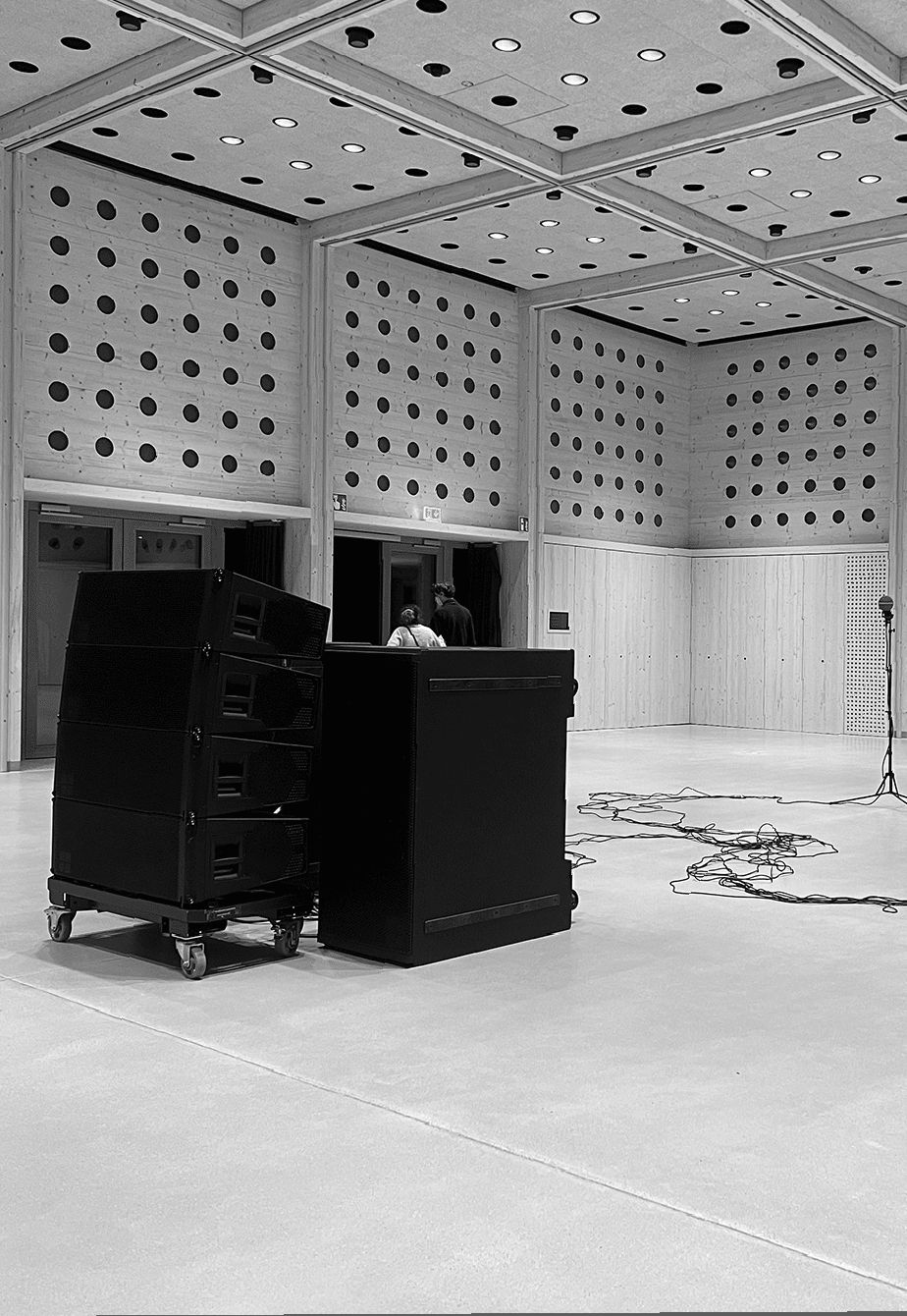
34121 is a digital tool developed by the Department of Sound (Direct Media) at the Kunsthochschule Kassel.
Initiated in 2020 under the name ftp-, and extending beyond its physical site located at Menzelstraße 13–15, 34121 Kassel, this platform maintains a continuous broadcast via p-node.org, functioning as an open access for a vast and ever-evolving sonic archive.
34121 encompasses sound documents of early avant-garde traditions, conceptual art, industrial culture, bruitism, noise, plunderphonics, microtonality, minimalism, dada, fluxus, musique concrète, actionism, echtzeitmusik, avant-jazz, ethnographic recordings, folk and traditional music, RIO, psychedelia, and a broad spectrum of countercultural and underground movements, including punk, post-punk, glam, no wave, and related liminal scenes. It also traces the histories of dub and club culture expanding towards intersections within the vast field of sonic culture.
Credits
© 2020-2026
ftp-direct.media / 34121.net
Impressum
Angaben gemäß § 5 TMG
Verantwortlich für den Inhalt nach § 18 Abs. 2 MStV
Prof. Mario de Vega
Kunsthochschule Kassel
Menzelstraße 13–15, 34121 Kassel
Deutschland
Kontakt:
mario_devega@uni-kassel.de
34121
Cat Woywod
Samuel Julian Grace
Jiayi Li
Digitalization and classification of archive
Muriel Koch
Concept
Web Design
Diego Asensio
Concept
Mario de Vega
Concept
Content
UI / Graphic Design
Web Development
Third-party content is credited where applicable
Acknowledgments
Diego Asensio
Kevin Bartoli
Andrea Bickenbach
Pia Christoph
Muriel Koch
Felix Hohmann
Víctor Mazón Gardoqui
p-node.org
Cat Woywod
Support
ADDAC System
ALM - Busy Circuits
Cosmotronic
Korn Produkte
LOM
Meyer Sound
p-node
Rumpsti Pumpsti
Musikrechte
Dieses Webradio sendet unter einer GEMA-Lizenz.
Lizenznummer:
[wird nachgetragen, gültig ab 01.07.2026]
This page fulfils the legal imprint requirements under German law (§ 5 TMG).
Datenschutzerklärung
Verantwortlicher
Prof. Mario de Vega
Kunsthochschule Kassel
Menzelstraße 13–15, 34121 Kassel
E-Mail: mario_devega@uni-kassel.de
1. Grundsätzliches
Der Schutz Ihrer persönlichen Daten ist uns wichtig. Diese Datenschutzerklärung informiert Sie darüber, welche Daten beim Besuch dieser Website erhoben werden, wie sie verwendet werden und welche Rechte Sie haben.
The protection of your personal data is important to us. This privacy policy explains what data is collected when you visit this website, how it is used, and what rights you have.
2. Hosting
Diese Website wird gehostet von: DreamHost, LLC, 444 S. Cedros Ave, Solana Beach, CA 92075, USA.
Beim Aufruf der Website werden automatisch Server-Logfiles übertragen. Diese Daten werden auf Servern in den USA gespeichert. DreamHost ist im EU-U.S. Data Privacy Framework zertifiziert. Rechtsgrundlage: Art. 6 Abs. 1 lit. f DSGVO.
This website is hosted by DreamHost (USA). Server log data is processed on US servers. DreamHost participates in the EU-U.S. Data Privacy Framework.
3. Radio-Stream
Der Audio-Stream wird bereitgestellt über ∏node (p-node.org), einen in Frankreich ansässigen Server-Dienst. Beim Abruf des Streams kann Ihre IP-Adresse temporär verarbeitet werden.
The audio stream is provided via ∏node, a server based in France (EU). Your IP address may be temporarily processed when accessing the stream. p-node.org
4. Kontaktformular
Wenn Sie unser Kontaktformular nutzen, werden die von Ihnen eingegebenen Daten zur Verarbeitung kurzzeitig auf den Servern von DreamHost zwischengespeichert und anschließend per E-Mail weitergeleitet. Rechtsgrundlage: Art. 6 Abs. 1 lit. b DSGVO.
If you use our contact form, your data will be temporarily stored on DreamHost servers and forwarded to us via email.
5. Externe Links
Diese Website enthält Links zu externen Websites. Für deren Inhalt und Datenschutzpraktiken sind wir nicht verantwortlich.
This website contains links to external websites. We are not responsible for their content or privacy practices.
6. Cookies
Diese Website verwendet einen technisch notwendigen Session-Cookie (echo_session) ausschließlich zur technischen Funktionalität. Er wird nicht für Tracking oder Werbung verwendet und beim Schließen des Browsers gelöscht. Rechtsgrundlage: Art. 6 Abs. 1 lit. f DSGVO.
This website uses one strictly necessary session cookie (echo_session) for technical functionality. It is not used for tracking or advertising and does not require consent.
7. Ihre Rechte
Sie haben das Recht auf Auskunft, Berichtigung, Löschung und Einschränkung der Verarbeitung (Art. 15–20 DSGVO) sowie das Beschwerderecht bei der zuständigen Aufsichtsbehörde.
Zuständige Aufsichtsbehörde: Der Hessische Beauftragte für Datenschutz und Informationsfreiheit, Postfach 3163, 65021 Wiesbaden.
You have the right to access, rectify, erase, and restrict processing of your personal data (Art. 15–20 GDPR).
8. Änderungen
Wir behalten uns vor, diese Datenschutzerklärung bei Bedarf anzupassen.
We reserve the right to update this privacy policy.
Stand / Last update: July 2026
Open call for internship positions in archive and classification. Intended for students and recent graduates working at the intersection of research, institutional knowledge, and collection practice. All positions are on-site.
Archive — Cataloguing, digitisation, and organisation of primary source materials. Contribution to archival infrastructure and access frameworks.
Classification — Development and refinement of taxonomies, indexing systems, and organisational schemas applied to our collections and research outputs. Work at the boundary between knowledge organisation and interpretive practice.
Regular supervision, access to collections and library, opportunity to contribute to live projects. Duration and compensation discussed individually.
Send a brief letter of motivation, CV, and relevant work samples. Indicate the position and describe your research interests in no more than 300 words. Applications reviewed on a rolling basis.